By Yavuz Yavuz from Istanbul
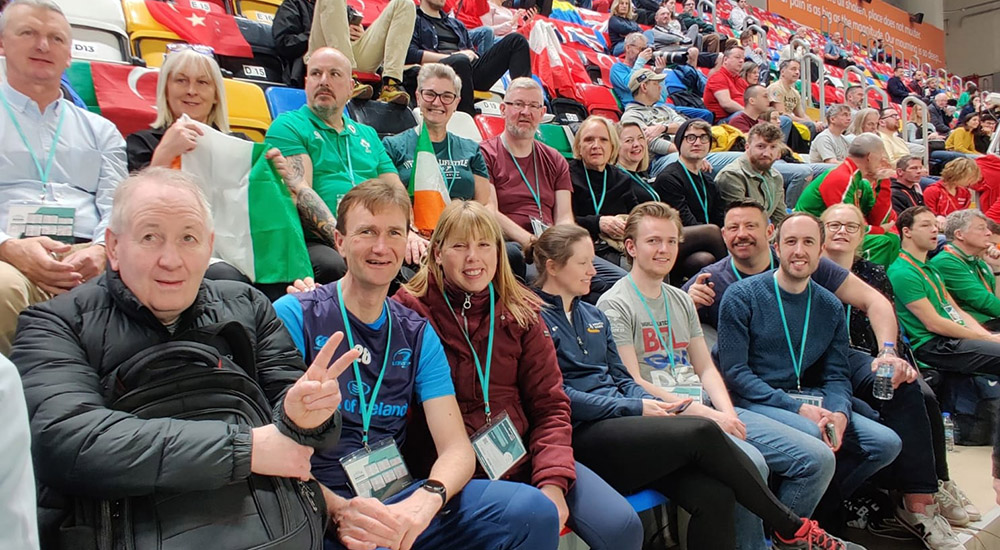
“Let’s go Darragh, you’re an animal!” shouted a spectator behind the Irish flags hanging from the stands of Ataköy Athletics Arena. Alongside different groups of athletics fans including those from the Balkan nations of Greeks and Serbs, who enthusiastically cheered for their medal contender athletes during the 2023 European Athletics Indoor Championships in Istanbul, another joyful crowd stood out as well. As I sat down with the large group of Irish fans to watch Darragh McElhinney run the men’s 3000 metres final, they both cheered on the 22-year-old middle-distance runner and commented on the race alongside other events going on in the field. While McElhinney made a very impressive kick in the final 500 metres but came just short of catching Serbia’s Elzan Bibic, his fourth place in the men’s 3000 metres became Ireland’s best result in the four-day continental championships.
“He’s going to be so frustrated, he shouldn’t be!” said Seamus Carey, the athletics enthusiast who brought together this group of fans who, since the Euro Indoors in 2015 in Prague, began groundhopping different athletics venues for following major championships. For the Athlone man, athletics quite really runs in the blood. Having an athlete for a father and a sister, he started following track and field from an early age and quickly became fond of the sport: “I think athletics is the perfect sport because there’s an athletics venture for every shape and body size, every gender, every age, literally everybody” Carey says. Nearly eight years ago, he began attending major championships, shortly after which he assembled a group of athletics lovers who loved to share the experience. During the session break of the final day, I sat down with Carey to dig deeper into the evolution of the fan group, as well as the current outlook of Irish athletics from a fan’s point of view.
PRAGUE, WHERE IT ALL BEGAN
For Carey, it all started with the 2015 European Indoors in Prague, the first major championship he attended in person:
“I was going with my sister; it was my first time going to a big international athletics event. I was following a lot of athletics people on Twitter, and I posted a message saying, ‘I’m going to Prague, if there’s any other fan groups around, I would love to meet up.’ So, we ended up meeting with a group of other fans with whom we stayed in touch, and we go to every event together since. Athletics is the common denominator that brings every one of us together, we are now more than 20 people from all over Ireland from Wexford, to Limerick to Cork, and even the UK.”
The group made it to nearly every indoor and outdoor European and World championships held in Europe since, as well as the 2019 Worlds in Doha. While talking about their plans of catching the World Championships in Budapest this August, Carey reminisces of the memories from the past:
“When you’re into athletics, you kind of think that you are the only person that is a fan or that knows about athletes or statistics. But then, when you meet other fans, you realize, ‘Oh no, there are lots of people that know this, and they know way more than me.’ So, one of the things the group always does is, when we sit down for dinner, someone just asks a quiz question and then everyone starts to think. It could be, you know, ‘name the 20 women who have run under 50 seconds indoors in the 400 metres’ and suddenly everyone goes silent and then we do a circle where everyone has to give their answer and if you give the wrong answer, you get knocked out. So, one of the big memories was realizing that there are lots of people who love this sport and have lots of knowledge. It’s great to meet those people and share the experience with them.”
When I ask about the most memorable results they witnessed, Carey immediately thinks about the most recent major championships they attended. While we laugh about the recency bias most sports fans tend to encounter when asked about picking a favourite every now and then, his choice is truly a remarkable one: “I think probably Ciara Mageean’s 1500 metres silver medal at the European Championships in Munich last summer. We know she’s always been a great runner, but she had lots of injury problems and to see her really take on Laura Muir in that last lap and not be afraid was really special. Ciara had a great year last season, it got a lot of attention and publicity from our national TV station, radio stations and local media.”
Obviously for a group of people who liked following sporting events collectively, some of the most challenging times were the pandemic lockdowns alongside other hardships of the period. These athletics enthusiasts covered the lack of live track and field events with online athletics discussions, which also made up for their sense of solitude during the time when most people had to stay home:
“We obviously tweet all the time and we have a WhatsApp group where we comment every day. It’s crazy, and it got even more intense during lockdown. But then, we also did a weekly online quiz, where each member of the group would have to come up with two quiz questions. We would spend an hour and a half on Zoom call chatting, and seeing who could get the answers. The questions became more obscure and funnier with PowerPoint displays and other things. That was great, keeping in touch with other people and then also watching a lot of old athletics videos together.”
THE IRISH BLAZINIG THE TRACKS
Having just watched Sarah Lavin make it to the women’s 60m hurdles final, I turn the focus on how the Irish sprinting surge seems in the eyes of a track and field fan. The Irish sprinters paced to history in last year’s European Championships in Munich, as Rhasidat Adeleke broke the national record and finished fifth in women’s 400 metres whereas another national record breaker, Israel Olatunde, ran the men’s 100m final. Adeleke also carried the Irish women’s 4x400 relay team to a first ever European Championships final. The 20-year-old, who ran the world’s fastest 200m this year and broke Karen Shinkins’s 21-year-old 400m indoor national record, was not available for the Euro Indoors in Istanbul, since she was in the USA, training for the NCAA D1 races. However, along with other prominent Irish sprinters, Adeleke’s name came up frequently in our conversation with Seamus Carey:
“I think what’s interesting is that Ireland always had a history in middle distance running. Then, in recent years, with people like David Gillick and Derval O’Rourke, we suddenly went ‘OK we can sprint as well’ There has also been the influence of the New Irish, that is the families from all around the world who have settled in Ireland and made Ireland their home. So, the influx of athletes like Israel [Olatunde] and Rhasidat [Adeleke] into the system has been super as well. For Israel, he had a gradual improvement over the last couple of years, he is still only 20, so I don’t think we’ve seen his full potential at all yet. But there’s a fantastic coach that he’s had in Tallaght, Daniel Kilgallon, who also trained Rhasidat Adeleke before she went to the NCAA.”
Carey also mentioned the dim chances of the Irish women’s 4x400 relay team in the final that night, as well as the promising future lying ahead of them: “I think we are blessed at the moment that we have a really strong pool of particularly female 400-metre runners. The good thing is that we have a great pool of athletes that should be pushing each other forward all the time, what’s bad, I guess, is that Rhasidat is based in the NCAA system, so she isn’t available for Irish competitions or Euro Indoors.
I would love to see them racing each other a bit more and driving each other on, because I think sometimes in Ireland, when you are a good athlete, you don’t want to put your reputation at stake by racing against another Irish athlete, so they do different distances to avoid each other. What’s lovely is that, I don’t know the internal dynamics but, from the outside they really seem like a good support group and they do all genuinely care about each other, which is really important for a relay team. I’m not sure if the team is ready to do amazing things this year, because there have been some injuries. Phil [Healy] is still recovering after COVID, Sophie’s [Becker] just back running again after some injuries as well, so let’s see what happens.”
Carey often emphasizes the collective aspect of training and competing in athletics. He tells me that he sees the stress that’s being put more and more onto this in recent years, also played a crucial role in the advance of the sprinters and other track and field athletes from Ireland:
“We have lots of athletics talent in Ireland but athletics as a sport isn’t great at getting the right talent early. I think one of the issues is, because it’s an individual sport, at a young age children tend to prefer to be a part of a rugby team or a Gaelic football team where they feel really part of a community. I think something that Athletics Ireland seems to have done really well over the last couple of years is getting training groups set up together so although you are an individual athlete, you are part of a group, part of something that you feel as a community. Be it the Dublin Sprint Club, or what Shane McCormack is doing with Phil Healy or the one that Feidhlim Kelly is doing with Mark English and Andrew Coscoran, you’re getting groups emerging.
The difficulty is that we don’t have a lot of funding for coaches. There is a new program this year, Athletics Ireland is now funding individual coaches, which is great, but I think the improvement is around finding the natural talent, having the right coaching system around them and seeing them develop through. Because we’ve always had great juniors who never quite made it through into seniors. Sarah Lavin would be an example of that, who was a wonderful junior athlete who then kind of stalled for a couple of years, suffered some injuries and is now finally fulfilling her potential again. It’s great to see her performance so well because we always knew it was there. We now realize that with some athletes there’s not a linear progression, there are ups and downs. The same applies to Ciara Mageean, wonderful junior athlete but had difficulties with injuries, and now is back to full fitness and performance.”
MIGRATION POWER
Ireland also had high hopes for a medal in middle distances, where they historically fared well. In anticipation of the night session’s men’s 3000m final, where we would watch Darragh McElhinney together, we go on to speak about the recent results of Irish athletes in middle distance races. This inevitably includes Mark English, who added a second European medal to his tally last August in Munich, after eight years. English was due to race in Istanbul as well but withdrew on the eleventh hour due to illness.
In the absence of English, hopes lied in Andrew Coscoran who had recently broken the 35-year-old Irish indoor 1500m record. But as Coscoran failed to make it to the final, Carey cautions about raising expectations over very recent results that are yet to prove consistent:
“One of the problems in athletics is we have such high expectations of everyone. When we see somebody running a fast time we think, ‘OK, that time translates into a medal!’ and then we forget that it might have been run in one race where there were no other competitors at that speed. Trying to repeat them in a championship with competitors from everywhere is a much different thing. We need to realize that a fast time doesn’t necessarily mean that we are going to do really well at the championships. We have a great pool of athletes that are beginning to live up to their potential, which is wonderful to see, and there are some people coming through from the juniors. Let’s see if they can all translate into performances and into medals.”
Before stopping the voice recorder, I also ask about the phenomenon of migrant and refugee athletes in Ireland. Among this generation of athletes emerging over the past couple of years, alongside sprinters like Israel Olatunde and Rhasidat Adeleke whose parent migrated to Ireland from Nigeria, there is also Efrem Gidey, an Eritrean refugee who arrived in Ireland in 2017 and came in sixth in the men’s 10,000m at the European Championships in Munich. Carey also briefly reflects on the political situation in Ireland and the widespread mindset regarding immigration in the country as he replies:
“It’s one of the things that I’m really proud of for both athletics and for Ireland. Ireland has a history of immigration, of having to leave the country either because of the famine or because of poverty. We know what it’s like to be an outsider in a new country, in a new world and trying to make your way. I’d like to think that we are very welcoming to people that are coming to Ireland, I think perhaps we can still be doing more, there are still some sectors of Irish society that are not OK with that. It’s a minority, it’s still a problem, but it isn’t as much a problem as it’s in lots of other European countries. I think sport is a wonderful tool for integration. We see that with the Gaelic Athletics Association, but we also see it with athletics and people like Rhasidat [Adeleke], Israel [Olatunde] and Efrem [Gidey]. They are Irish athletes running for the Irish team that we as the Irish people support, and it is great to see because the more diverse our population is, the better for everyone.”