By Yavuz YAVUZ
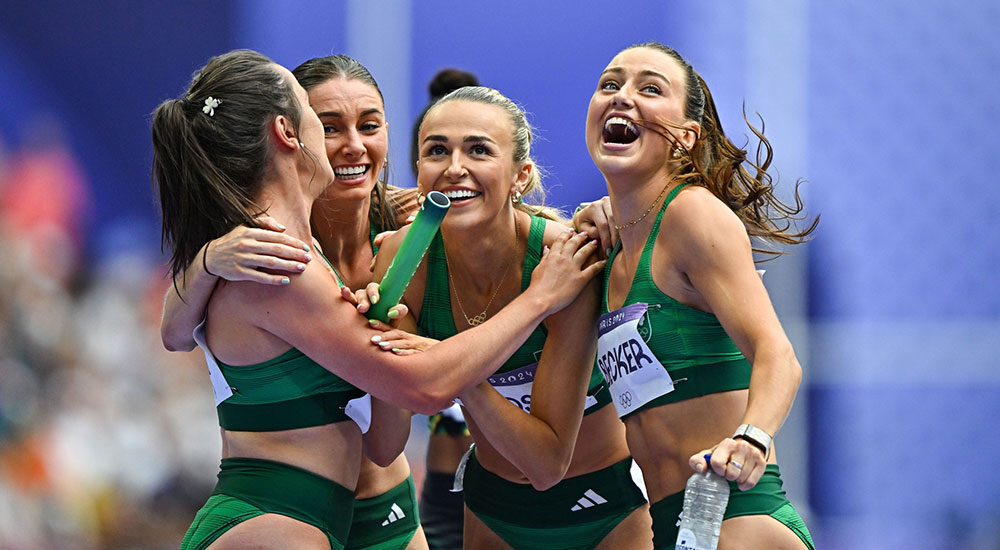
Sophie Becker, Rhasidat Adeleke, Phil Healy, and Sharlene Mawdsley. When this quartet first ran together, it was in the heats of 2022 European Championships in Munich. The time they ran, 3:26.06, was a massive national record that scraped 1.42 seconds off the previous one from 11 years ago. More importantly, this cemented the Irish women’s and mixed 4x400 teams place as nothing short of a constant in major finals.
Two years on, the 3:26.06 only sits at fifth place in the Irish all-time toplist of women’s 4x400 marks. The Irish quartet are now European silver medallists, as well as fourth place finishers at the Olympic Games.
In the run up to the 2024 European Championships in Rome, the depth of Irish 400m runners was among the biggest highlights, and the team delivered on this hype with a stunning gold medal in mixed relay ahead of Italy and Femke Bol’s The Netherlands, as well as a silver in women’s 4x400 behind the Dutch team. They advanced to the women’s final with the help of Lauren Cadden, and with the addition of Adeleke in her stead in the final, they renewed their national record once more with 3:22.71.
Ireland arrived in Paris on this note, and with a deep contingent of full lap runners. But things did not start as planned, with the mixed team falling in the heats in the absence of Rhasidat Adeleke. Nevertheless, Sophie Becker, and Sharlene Mawdsley – half of the mixed relay team that ran in Paris – quickly recovered from heartbreak and produced impressive results over the individual 400m heats, despite not advancing to the semi-finals. Sharlene Mawdsley’s 50.71, for instance, is now the second fastest time in Irish history, right after Rhasidat Adeleke’s national record of 49.07.
Because Adeleke was preparing for the women’s 400m final – the first dash sprint final to ever feature an Irish athlete in Olympic history – Becker, Healy and Mawdsley ran with Kelly McGrory in women’s 4x400 heats. McGrory, who clocked 52.62 seconds this season and moved to eleventh in Irish all-time list in 400m, showed up to the task and Mawdsley ran the fastest and only sub-50 seconds split in the heat, which helped them finish third and get an automatic qualification to the final. History was set.
THE AGONY OF THE FOURTH PLACE
The eve of women’s 4x400 final in Paris saw Rhasidat Adeleke fall devastatingly short of a medal in women’s 400m final, by clocking 49.28, 0.3 seconds behind Poland’s Natalia Kaczmarek who won the European title ahead of her in June as well. She took the field 25 hours later to run the relay final.
And what a field it was. The final race in Stade de France proved to be one for the history books from the get-go. Sophie Becker handed the baton to Adeleke in 50.90 seconds, placing Ireland third behind the USA and The Netherlands. Second leg was Sydney McLaughlin-Levrone against the rest of the world, as the 400m hurdles world record holder flew to a stunning 47.71 split. Rhasidat Adeleke, in the meantime, proved to be the best among the rest of the world as she handed over to Phil Healy in second place in 48.92 seconds.
Phil Healy, found her top form in relay races this year after struggling with post-COVID symptoms for nearly two years, ran a solid 50.94 lap to hand it over to Sharlene Mawdsley, who was on her 26th birthday.
Mawdsley has proven time and again to be a reliable anchor leg runner, and she did her best in a race that was out of this world. She clocked 49.14 but the USA was on a flash run, as they stopped the clock at 3:15.27, the second-best mark of all times and just 0.1 seconds off of Soviet Union’s world record from Seoul 1988. Both McLaughlin-Levrone and anchor leg runner Alexis Holmes (48.78) ran sub-49-second splits. In the meantime, Femke Bol did an amazing job once more. Just like in the mixed race where she cruised The Netherlands to gold medal, she took the baton in fourth place once more and carried the Dutch team over the line in second place with a staggering 47.93 split. Britain won bronze with a national record of 3:19.72.
In a race where four teams dipped under 3:20.00, the USA clocked an area record, and four other teams ran national records, Ireland lowered their own to 3:19.90. In fourth place, they stand right on the edge of the podium, and as gruesome as missing out on a medal in such a race may be, they were part of history.
Ireland has gradually cultivated an extremely promising sprint pool, that has also proven quite capable of running in harmony in relay races. Two fourth places at the biggest stage of the sport is surely devastating. But in the course of the development of this program, it shows there is a solid ground to build better results upon. Sprint programs in Dublin, Tallaght and West Cork produced the talents that brought Ireland here, and with hard work, medal positions as well as gold ones seem right around the corner.
Just like Rhasidat Adeleke said during the interview on RTÉ right after the final: it’s only “onwards and upwards” from here.