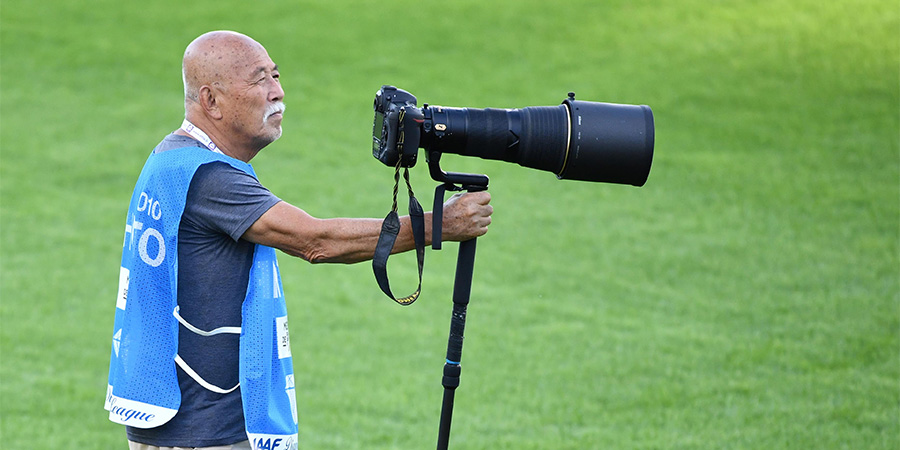
We caught up with world-famous photo journalist Jiro Mochizuki in London. He was still ambitious about taking photos and shooting world-class athletes. He took up to a journey from his native Japan to Ethiopia, where he frequently visit.
Mr. Mochizuki, how did you start on photography?
It was started because of my dad. He was very curious about photography. I was born in Tokyo in 1941. But we escaped from WWII American bombings in Tokyo through to the countryside. Settled in a village near Fuji. Very small place. After the war, we did not back to Tokyo, either. Years later, I return to the capital city for photography education. Of course, I have some essential knowledge about it, but school in Tokyo gave me such a broader view of it.
Actually, you had a lot of shooting in different areas, but everybody knows you as an athletics photographer. Did you follow every single big championships from your career starting point? For example, back in 1983, Had you been in Helsinki, very first World Champs out there?
Yes, I watched 1983 Championships but not as an accredited photo-journalist. But after that, I shot every one of them. Europeans, Africans, some of the American and Asian Champs, too. Particularly, I focused on long-distance running for some period, followed and shoot lot of major marathons.
I guess you’re not working for big news agencies, do you?
No, I’m not. I own my photo agency named SHOT, together with my fellow photographer, Takashi Ito. We get together our collection in same pool. Japanese section of our agency is doing mainly soccer, have a contract with J-League. Mainly we worked them in Japan.
I heard about you’re shooting about only athletics…
I shot different sports previously from soccer to rugby. But now, yes, I’m shooting only athletics. The last 10 years, I did not shoot any other sport.
If you’re guessing an approximative calculation, how many pictures have you stored so far? Over one million?
Don’t know. Many. I did not count them, no need to do this. Even I don’t have time to count them. Meanwhile, I’m not kind of serial shooter. New generation photographers mainly do that; continuously shooting. They’re growing up in a digital world, that’s why we accept it as “normal”. But I was doing it by filming, still doing it sometimes, with old school methods, even though it’s more expensive.
Sure, had many frames in your mind. but, if you select one of those moments, which one it would be?
I’m not sure if you remember or not; we were in Athens Olympics Games men’s marathon race in 2004. A bunch of 20-25 international photographers in a photo truck were in the lead. Brazilian athlete (Vanderlei de Lima) was going to the finish as race leader. We were reached almost 37-38th kilometers of the race as everybody had been boring about the race thinking as ‘nothing happened on course’, some photographers were doing preparation on their machine for finish photo. Some others had been dropped their camera on the ground to breathe a little bit. Suddenly, an attacker dive into the marathoner, and luckily I was already focused on the marathoner in that specific moment. I shot whole sequences in that historic moment as other photographers did not. That day, every news outlet in the World distributed my photos to their subscribers. It was completely lucky moment. You cannot come across that kind of moment in your life.
Several years ago, a French photographer (Olivier Morin) caught 'The Lightning Bolt’ sequence in Moscow, too. Similar moment-catch, isn’t it?
Surely. It’s completely luck, nothing else. If you’re on timer in that second, that’s it. The photo is done! You never know it before.
Before sports photography, did you have worked some war, landscape any other specific area of shooting?
Partly, I do. I was shooting black-white photos with a lot of journeys. Starting from my native, Japan, I visited all Asian continent, Europe, Soviet Union, Turkey, Iran, Jordan, Israel… I walked through every inch of those countries. Shot black and white photographs in that geography and made some spectacular exhibitions. Nothing about sports. In 1968 when I became a father, we got back to Japan for a while. Then I started to shoot some other things.
You published several photo books. Can you tell us a little bit about books?
I have published a book about Haile (Gebrselassie). Now, I’m doing similar album on Kenenisa Bekele. He was asked it to me. I know him since he was a kid. Also, the family of Tirunesh was magnificent. Four sisters and every single one a champion. Can you realize how’s interesting to make stories about this family? Shooting specifically on the family and their ordinary/extraordinary life. Amazing.
I think you have ties of affection on Ethiopians… Have you distanced from Kenyans compared with their neighbors?
I connect and discuss with Kenyans too, but I stayed a lot in Ethiopia, maybe the main reason to I’m looking to closer them. I flew twice to Ethiopia every year and lodged in Haile’s big house. I have a room there! I’m so lucky to have a great friend like him. Kenenisa is the same. Whenever I want to get Addis, these guys welcoming me very warmly. Every time.
You should be missing Haile as competitor because his legacy was not fully fit since he retired. Kenenisa made another impact on distance running, but Haile was different…
Right. They are different. Haile is in interactivity with his around, shows his emotions quickly. The persona which is every photographer prefers. On the contrary, Kenenisa is self-conscious, quiet, and shy.
And finally, the last question about photography again. New technologies and set-ups are overcoming human instinct in the photographs?
It’s not happening only in photography, but the life. Everything is going to be mechanical way in our daily life. You cannot stand against it. It’s about human civilization and its processes. Irresistible.
Still doing manual settings or not on the field?
Yes, I used manual everything I have. Nowadays the cameras are like computers, not ordinary cameras that we used for years. But personally, I’m not so interested in technology. I want to mess around with photos, not cameras.
* Interview by Şevket F. Erbay during London World Championships 2017.