By Evren Özüyener
One of the greatest runners of all time, a truly unique man, Emil Zatopek was a figure of huge importance in the history of athletics. His self-developed system of high-volume interval training has led him to be an undisputed legend. The “Czech Locomotive” who will later revolutionize the athletics during the era he ran, was discovered at the age of 16, when he came second out of a field of 100 athletes, in a race organized by his managers at the shoe factory, Bata in which he worked in Zlin.
Emil was the sixth child of a modest family. Unlike most of the kids in town, he was not good at football but soon he realized that running is a kind of escape from his surrounding in those days. He was not the most naturally gifted athlete but what made him the greatest of all time was his willingness to training.
In addition to joining the army in 1942, Koprivnice-born athlete began representing his country during international events. In 1944 Emil broke the Czech records for 2,000, 3,000 and 5,000 meters. He was selected for the national team for the 1946 European Championships. He finished fifth in the 5K.
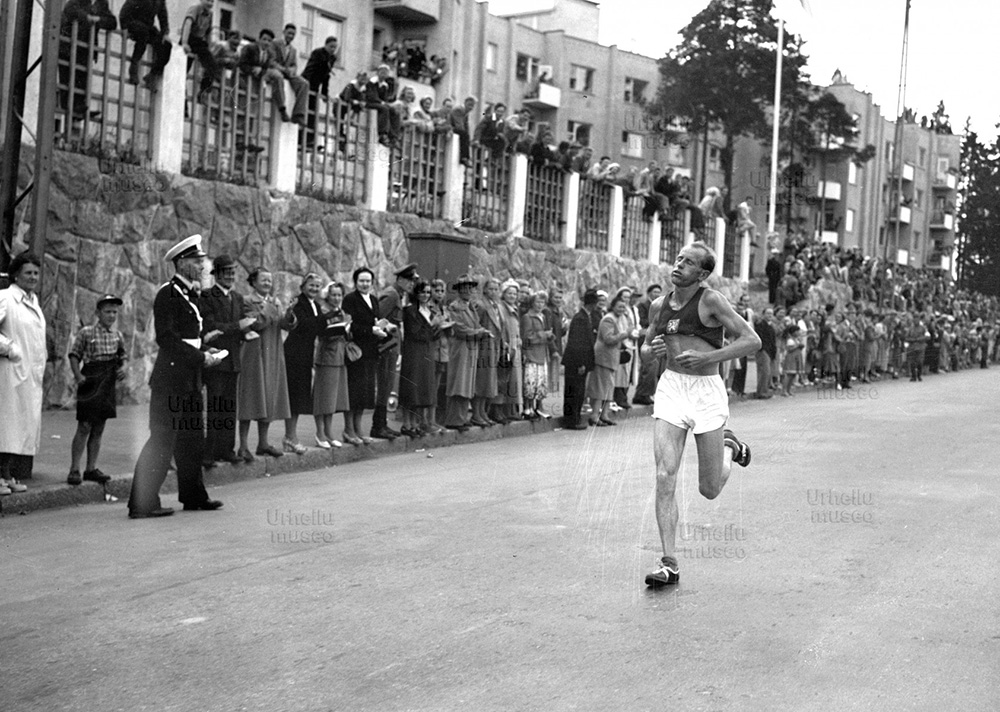
In his Olympics debut, Zatopek won the gold (10,000m) and silver (5,000m) medals at the 1948 Olympics in London, before claiming three gold medals in the Helsinki Games four years later. Between 1949 and 1951 Zatopek competed in 69 long-distance races and won all, including a 10,000 m gold medal in European Championship.
TRAINING MONSTER
By the mid-1950s he was doing up to 100 fast 400m laps a day, with 150m jogs in between during in his training sessions. His self-developed system of high-volume interval training has become a guide for elite runners. His style has always been described with so many different terms but the man of incredible comebacks and performances said, “Why should I practice running slow? I already know how to run slow. I want to learn to run fast" when asked about his training routine.
Emil Zatopek soon became a global star. He was welcomed very much warmly by many countries. On and off the track his talent and personality made him a role model for many people to follow. Emil was not just a great athlete but also an extraordinary person. Although he suffered from illness ahead of the 1952 Olympics, his triple in Olympic distance-running events at Helsinki in 1952 (including a debut marathon) is unlikely ever to be matched plus he set a new Olympic record in all three events. His wife, Dana Zatopkova, a javelin thrower also cruised to victory at the 1952 Helsinki Olympics, just an hour after her husband won the men’s 5,000m run.
Undefeated at 10,000m for six years, he revolutionized his sport. 1954 was a year full of worldwide visits and claimed 10,000 gold and 5,000 m bronze at European Championship.
AFTER RETIREMENT
Due to injury ahead of the 1956 Olympics, after finishing sixth in the marathon, the following year he retired from running competitively. While his career in sport was over, Zatopek remained a high-profile and influential figure in Czechoslovakia after retirement as an athlete.
But during the 1968 Prague Spring, Zatopek was punished for his part in the failed revolution. Having been a hero to Czechoslovakians and one of the most famous icons on the planet, he suddenly descended to a low position and was sent away spent years far from his wife. He was put to work in the city’s sanitation unit, collecting rubbish, and went on to spend years working in a mine or as an archivist at the Sports Information Center in Prague.
In 1990 he could finally return to a life of calm. The iconic Olympian died ten years later in Prague on 22 November 2000 aged 78 following complications from a stroke.