By Athleticspodium - Editorial
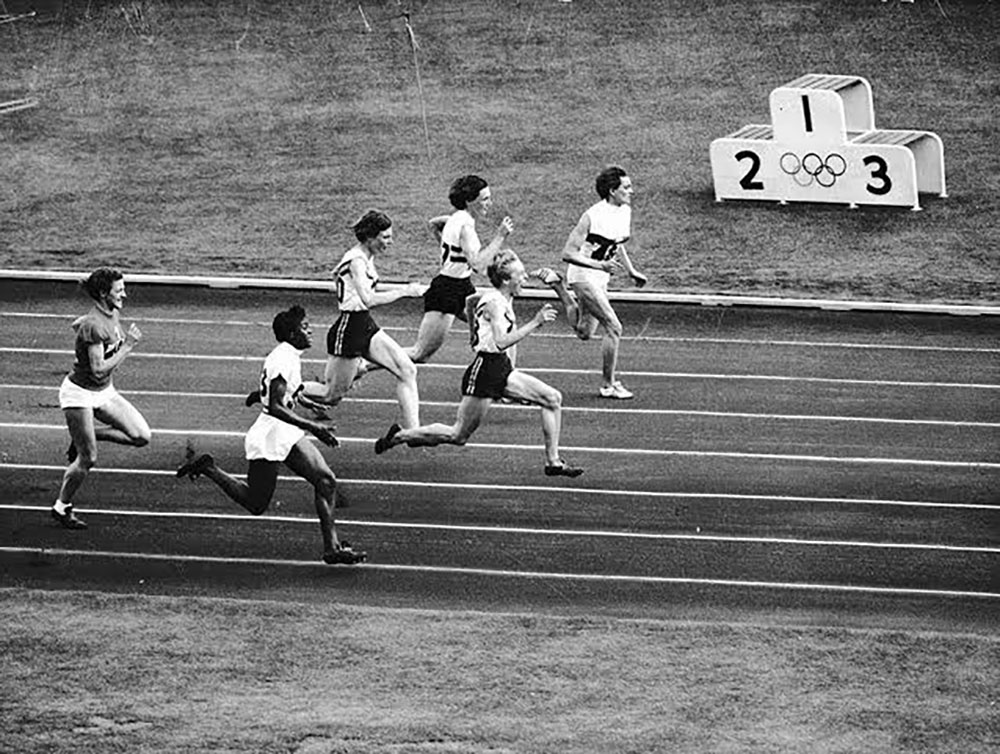
Athletics competitions at the first Olympic Games held in the Southern Hemisphere began on a hot Melbourne day exactly 70 years ago today (22 November 1956). With 61 countries represented, champions were crowned in 33 events, and six world records were broken. While the “Golden Girl” Betty Cuthbert and American Bobby Morrow dominated the sprint events, Soviet athlete Vladimir Kuts followed in the footsteps of Emil Zátopek, who had made a tremendous impression in Helsinki four years earlier, by winning the 5,000m, 10,000m and marathon. Zátopek also competed in Melbourne, but on a hot day, he finished sixth in the marathon, four and a half minutes behind the winner.
Texan Bobby Morrow arrived at the Games as the AAU champion. He won the 100m in 10.5 seconds and claimed victory in the 200m by equaling the world record of 20.6 seconds. Morrow finished more than three metres ahead of Andy Stanfield, the defending Olympic champion in the 200m. The 21-year-old American sprinter secured his third gold medal in the relay. The United States, favourites to win the 4x100 metres, took gold in 39.5 seconds, beating the Soviet Union.
The Soviet response to America's dominance in the sprint events came in the long-distance races. Born in the rural region of Sumy, Ukraine, Volodymyr Kuts served in the Soviet Navy. Before the Games, he had defeated leading athletes, including Emil Zátopek, and broken the 10,000m world record; before arriving in Melbourne, Kuts claimed two victories at the 100,000-capacity Melbourne Cricket Ground (MCG), with the races held five days apart. The 29-year-old won the 5,000m in 13:39.6, crossing the finish line an astonishing 11 seconds ahead of the runner-up.
The 18-year-old Australian sensation Betty Cuthbert became forever associated with Melbourne 1956. Like Bobby Morrow, Cuthbert won three gold medals in the 100m, 200m, and 4x100m relay. She added another gold medal in the 400m at the 1964 Tokyo Olympics, becoming the only athlete in Olympic history to win gold in all three sprint distances.
Alongside Cuthbert, Australia's leading female athlete of the era, Shirley Strickland, also took centre stage at the Melbourne Cricket Ground. Strickland successfully defended the 80m hurdles title she had won four years earlier, defeating Germany's outstanding athlete Gisela Birkemeyer. She also claimed another gold medal in the 4x100m relay. With seven medals across three Olympic Games, Strickland secured her impeccable place in Australian sporting history.
Shirley Strickland, who grew up in Western Australia, was the daughter of Dave, a former sprinter who had won the Stawell Gift, the country's most prestigious amateur race. He couldn't afford the trip to the Paris 1900 Olympics, despite desperately wanting to compete. Half a century later, however, his daughter would give him an extraordinary reason to be proud.
Hal Connolly, who would go on to make history a few years later as the first hammer thrower to surpass 70 metres, won the hammer throw with an Olympic record of 63.19m. Having qualified for Melbourne by finishing third at the American trials, Connolly delivered a significant victory for the United States, which had not won the event since 1924. He narrowly defeated Soviet world record-holder and European champion Mikhail Krivonosov by just 16 centimetres. Connolly's future wife, Czech athlete Olga Fikotová, whom he met at the Games and later married in a highly publicised ceremony in Prague, also became an Olympic champion in the discus throw.
In the men's discus, American Al Oerter began the remarkable run of four consecutive Olympic victories that would make him a legend of the sport. Just 20 years old when he arrived in Australia, Oerter won the event with a throw of 56.36m in Melbourne. By the time he claimed his fourth and final Olympic title at Mexico City in 1968, he had improved that mark to 64.78m.
In the javelin, an unexpected name claimed gold, setting a world record in the process. Norway's Egil Danielsen used a new-model steel-alloy javelin lent to him by Poland's Janusz Sidło, who would eventually finish second in the final. Danielsen improved Sidło's world record of 83.66m to 85.71m with his winning throw. That year, he was named Norway's Sportsman of the Year, surpassing the country's heroes from the 1956 Winter Olympics in recognition.
In the women's high jump, American Mildred McDaniel comfortably won the title with a leap of 1.76m, finishing well ahead of her rivals. The next six athletes in the standings all recorded 1.67m. Among those separated by countback was 20-year-old Romanian Iolanda Balaș, who finished fifth and attracted relatively little attention.
However, Balaș, who made her Olympic debut with a fifth-place finish that day, would go on to dominate the event for the next decade, remaining unbeaten in every competition she entered and never losing another Olympic gold medal opportunity.