TFN: You only ran the intermediates once in ’75, so when did you decide to concentrate on them?
EM: About the middle of March. Earlier in the year, I looked at the Olympic Trials schedule and I figured I could make it in the quarter and the highs (110H). I hadn’t given the intermediates any serious thought. I had myself programmed to run 45 in the quarter and 13.5 in the highs [he eventually ran 46.1 and 13.9]. Those were my goals for the year.
I had talked with coach last year about the intermediates, but never worked on them and never had time for them in the meets. I ran the highs and then would come right back in the quarter, so by the time the IH came around I was getting ready for the mile relay. I didn’t have time for four events, and three of them hard quarters in every dual meet.
TFN: How did you feel about the race when you first started running it?
EM: I didn’t know what it would take or what to expect. For the Florida Relays, which would be my first serious meet in the IH, coach sent in that he tought I could run 50-flat. I thought he was crazy. So I was put in the fast section, but once I started running them, I felt pretty comfortable. I ran 50.1 and I wasn’t tired at all. I had just been doing overdistance workouts, 1000s and 600s. None of those special workouts for the IH that coach came up with later.
TFN: You said once that 15 strides actually slowed you down. When did you start working on going 13s all the way?
EM: I’ve never run 15s. At Florida I ran 13s until the sixth hurdle, ran 14s for two and then 13s to the finish. I knew even then I could do 13s all the way, but I didn’t do it because the race was new. So after that, I worked on 13s. all the way. I just did everything in my workouts with 13 strides.
TFN: When id you become serious about trying for the team in the 400 hurdles?
EM: Right after that 50.1. I knew then I could run 48 and the season got on and I was running 48s and just easing through them, I knew I could run 47. I just kept working at it.
TFN: Did you think you would have to be in a race the caliber of the Olympic final run that fast?
EM: No, I was on pace to that in the AAU, before I started stepping on hurdles.
TFN: You make it sound so easy, and it looks easy. There has been a lot of training and concentration, but do you know why it seems to come easy for you?
EM: Most of the hard work and concentration is done in practice, son when I get into a meet I know what it’s going to take. I know what mistakes I’ve made during the week and in the race I just concentrate on what I’ve done during the week. I’ve got a log of all the mistakes I’ve made. My coach and I knew that I would have to get in just four months all the experience that those other guys got over the years. So we were just that much more intense.
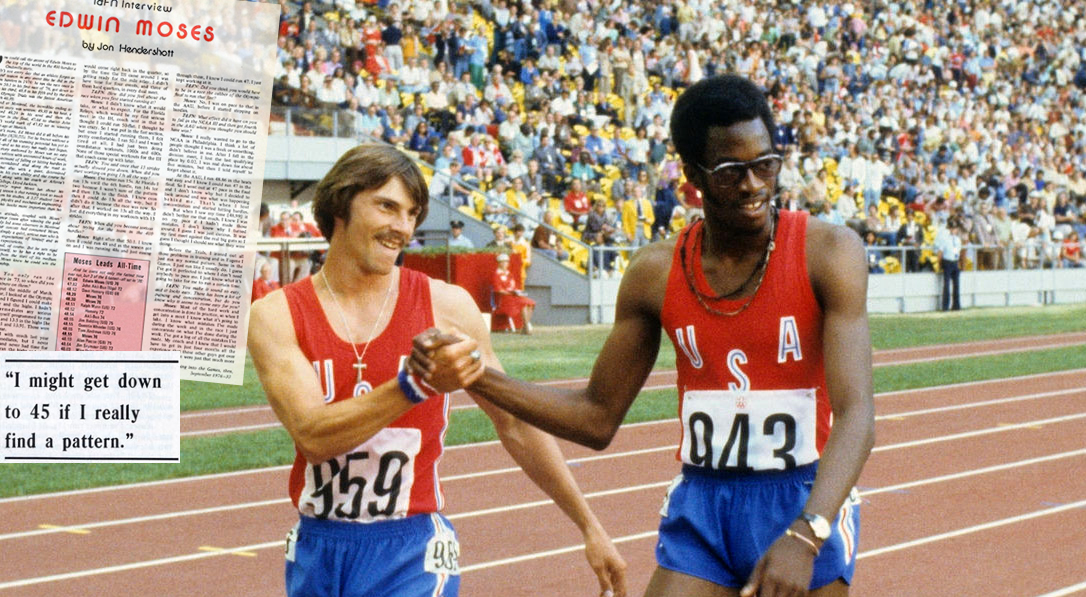
TFN: Going into the Games [Montreal 1976], then, how did you see you chances?
EM: I had a bad week of practice before the Games. I men I felt bad, my legs were sore from the change of tracks between Plattsburgh and Montreal. But my times were right where they were supposed to be. Then in a practice meet I ran 49.3 in the hurdles and a 45.2 relay leg. I though they were about 50.5 and 56.4. I knew I was ready and I just had to get into the race.
The first day I ran 49.95 and that was just a shake-out. I started decelerating right after the 10th hurdle. I know I could have run 48 that day, so after that I really wasn’t worried.
TFN: The African boycott took out John Akii-Bua, but would it have made any difference to you to have had him in the race?
EM: I think the final time would have been faster. I really feel I was in shape to run 46-point. I had programmed myself to be ready to run that if necessary. I was really looking forward to running against Akii-Bua.
TFN: How did the semi go?
EM: I thought I was running around 49-flat, but it was 48.29. I knew I was right there I was supposed to be. I was relaxed and not worried about the final. I looked at it as just another race. All I had to do was not make any mistakes. I thought it would take 48-flat to win, at the most. I knew I could run 47.5 and 47.64 is exactly that converted from automatic time.
TFN: And the final?
EM: I had a slow reaction to be gun, one of the slowest I can remember. I must have lost at least a tenth at the start and another tenth getting to be first hurdle. I was off balance at the first hurdle.
After that, I started smoothing out and I accelerated down the backstraight. At the fifth hurdle, all of a sudden I saw the Russian (Yevgevy Gavrilyenko) going into the corner. We hit fifth hurdle about the same time, but I hit the sixth ahead of him. After that all I could see was the rest of the hurdles. I just maintained my normal pattern. I really wasn’t sure about the race until the 10th hurdle. After the tenth, I cut my stride down more for speed and just went on into the tape. But I know I made at least five or six-tenths worth of mistakes.
The time didn’t surprise me, if it had been close to 47-flat I would have been surprising. I was in shape for a time like that for more than a month but I never had the opportunity. The Games were the perfect opportunity and I capitalized on it.
TFN: You talk about mistakes, so it wasn’t a “perfect” race for you?
EM: No, not at all. Right now, I’m working on a program so I can run 46s in just a matter of time. I might get down to 45 if I really find a pattern. I’m capable of doing that and it’s reasonable, too.
TFN: Is 12 strides one of the keys to running that fast?
EM: Yes and I’ve worked on that in practice. I’m doing it comfortably, more so than before the Games when I was concentrating on 13s. I didn’t want to work hard on 12s then because I didn’t want to upset the pattern I had.
TFN: We spoke of opportunities: what kind of opportunity would you need to run that fast?
EM: Moscow in 1980. It’s a long way off, but my consistency right now is around 48.3 anytime I get on the track. In the next couple of years, it will be down to 48 and below.
TFN: Does 46 seem formidable to you is it just a natural progression?
EM: It’s a bit of both. I’m definitely going yo have to work it at, but I know I can do it. I know I can do 46.
TFN: You seem to set a very tough standard for yourself and you don’t seem satisfied yet because you feel that you can so much better.
EM: Yes, that’s true. I think a lot of that is due to my major. A lot of time you’ll get a problem in physics, you may work three or four hours on that problem, but you may get it wrong and not even come close. It’s disappointing. I know I get to the point sometimes where I don’t even react to things. I gave a good time and I’m happy, but things don’t excite me a lot. Being in school for nine months is pretty intense and I don’t have time to react.
TFN: School is very important to you, as important as athletics?
RM: More important. There are times when I regret losing time from school because of track. I could gave had 4.00 average, but I had to make sacrifice. I wouldn’t trade my gold medal, but that’s one reason I had to win it – anything less would have been disappointing. I put in so much and anything less would be like I wasn’t getting something back.
TFN: Before this year, had you ever considered what the term Olympic champion meant?
EM: No, I hadn’t. Thinking now, I guess it means the way people react to you. I guess it means you’re the best in the world.
TFN: Might it be hard to live with?
EM: I’m adjusting now. At first everybody was pulling at me and turning me around and I had to say, “Hey, wait, slow down”. I never really thought about that part of it beforehand. I just thought about the medal, not what would happen afterward.
One thing is that now I know I’m in a position to help people or to make people happy and I’m glad about that just by talking to people or shaking their hand it makes them happy. That makes me feel good.
Interview by Jon Hendershott. Published on Track and Field News, September 1976.