By Yavuz Yavuz
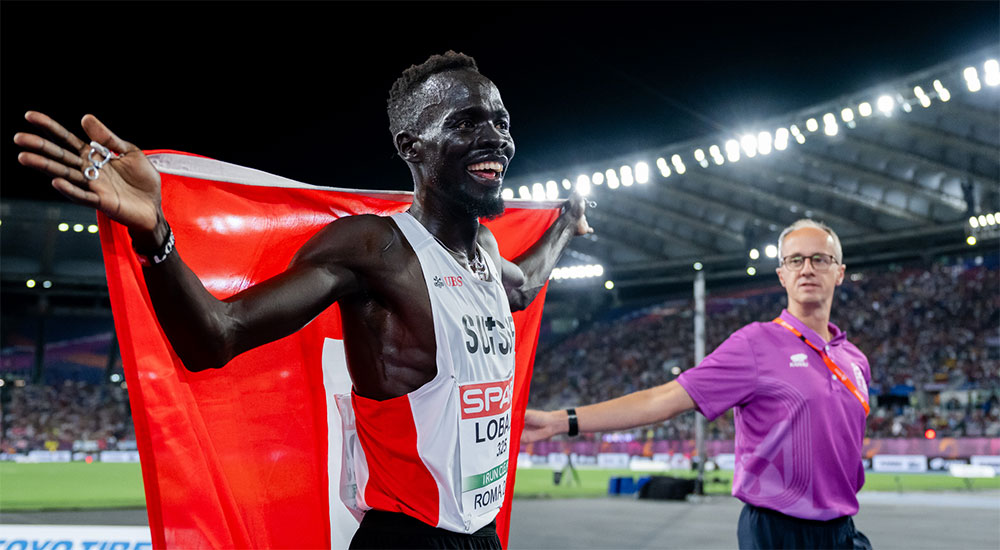
Switzerland is not familiar to success in distance races on the track. But this changed recently with Dominic Lokinyomo Lobalu having a great championship at the Euros in Rome. What was more important, however, was the long journey Lobalu made from home.
Born in Chukudum of (now South) Sudan in 1998, Lobalu lived through the bloody civil war and genocide that tore the country. Both his parents were killed during the Second Sudanese Civil War, causing him and his four sisters to flee the village that they lived in. Having spent nearly 10 years at an orphanage, he then crossed the border to Kenya, where he started playing football in school. He then picked up running and started racing middle and long distances. In September 2016, weeks after the Refugee Olympic Team made its debut in Rio, he received an offer to train with a peace foundation led by Tegla Loroupe, who let the two-time world bronze medallist in 10.000 metres.
INTERNATIONAL DEBUT
After making his debut on the international scene with the 4x800 race at the 2017 World Relays with the Refugee Team, he went on to race in men’s 1500m at 2017 World Championships in London. Having failed to advance to semi-final, he transitioned to long distances.
While he ran with the Refugee Team for a while, this stopped abruptly when he decided to leave during the Geneva Half Marathon in 2019. Citing poor training conditions and little room for improvement outside the boundaries drawn by the Team, he left and applied for asylum in Switzerland.
During the time he waited decision on his application, he requested access to training facilities and after some great effort, he was put in touch with coach Markus Hagmann who still trains with him.
Lobalu turned eyes to himself in 2022, when he won the 3000m race at the Stockholm leg of Diamond League. Clocking 7:29.48, he beat Jacob Kiplimo of Uganda, the 10.000m Olympic bronze medallist from a year earlier.
FIGHT FOR THE RIGHT
In 2023, a documentary titled The Right to Race, surrounding his condition as a refugee who was denied the right to compete as one (due to his previous departure from the Athlete Refugee Team) was released. After that, Swiss Athletics Federation stepped in to reinstate him in the team with a plea directed towards the IOC, because otherwise he would have to wait 10 years before gaining citizenship in Switzerland. IOC eventually ruled in favour of Lobalu competing for Switzerland from April 2024 onwards.
This is how Lobalu came to represent Switzerland at the 2024 European Championships in Rome. Meanwhile, Switzerland had not previously been looking for success in 5000 and 10.000 races. While in the former the country did not see a podium finish from its athletes since 1978 – when Olympic medallist from 1984, Markus Ryffel won silver – in the latter, it was Daria Nauer’s bronze from 30 years ago that put Switzerland on the event’s records.
Lobalu managed to medal in both events. He started with a bronze in men’s 5000m, where trailed behind Jakob Ingebrigtsen and Britan’s George Mills. Then he topped the race at men’s 10.000m with a time of 28:00.32 to win gold.
Lobalu’s haven’t been an easy life. He struggled through wars and genocides and poor treatment of refugees in Europe, and finally climbed to the top of the continent’s track and field scene. His departure from the Refugee team kept him from a chance to compete at the Olympics in Tokyo. Now, although there is still a long way to go, he can dream of things even bigger.