Words by Sevket F. ERBAY
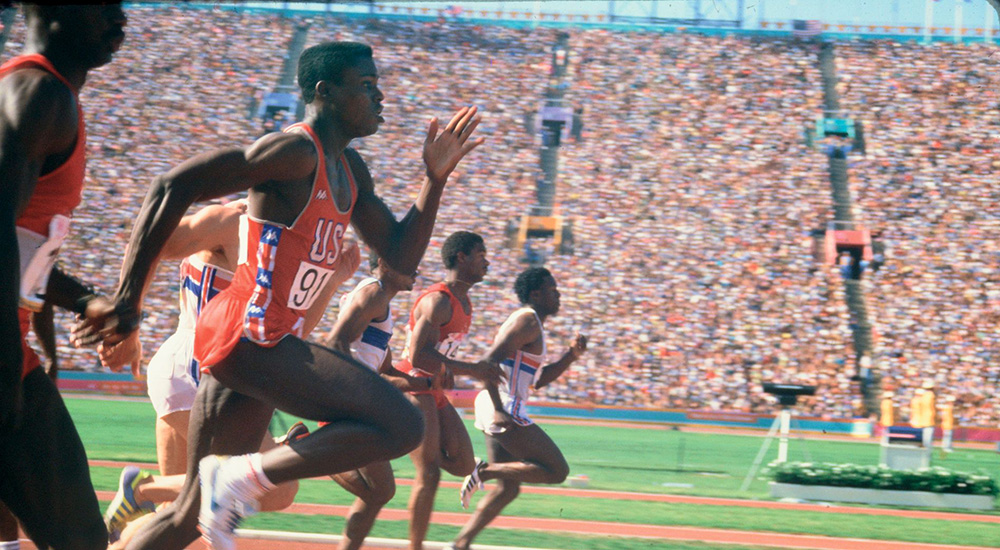
Carl Lewis is the only athlete with four gold medals at a single Games in modern times of athletics. The rest of the great names to do so (Alvin Kraenzlein, Paavo Nurmi – twice, Ville Ritola, Jesse Owens and Fanny Blankers-Koen) were from the early era; the competition level was relatively weak and lowly. At some point, the authorities argued that the strongest Olympic field didn’t challenge Lewis due to the Eastern Bloc boycott in Los Angeles. However, it’s not a grounded argument, as Lewis had already tightened his grip on specific events during the season.
When we checked the 1984 performance list in 100m, 200m, and long jump, we can see Carl Lewis was on top, and no prominent communist bloc athlete was around unless three of the Top 10 performers in the 100 metres and six others in the long jump. If they had participated in the Games, nobody would have been challenged against top-shaped King Carl; maybe a little chance of Polish Marian Woronin, who broke the European 100 metres record in June 1984 by clocking 10.00 in Warsaw (In addition, he contested 'Eastern alternative' the Friendship Games and eliminated in the 100m heats).
Carl Lewis was immensely fast and furious in the summer of 84. His incredibly focused action on track led to one of the greatest athletics sagas ever. The 23-year-old entered the pitch on the morning of August 3rd and became a 4-time gold medallist and a world record holder in just eight days.
3 AUGUST
The 100-metre heats began without world record holder Calvin Smith, who could not make the US team in the trials. Carl Lewis opened his campaign with a 10.32 win in heat one, featuring 1976 Olympic champion Hasely Crawford of Trinidad. Three hours later, he sat on the starting block again for the quarter-final and clocked the best mark of the day: 10.02. His closest rival was teammate Sam Graddy with 10.15 in the other quarter-final heat.
4 AUGUST
The next day, Lewis matched up with 'future' bitter rival Ben Johnson of Canada in the semis. He made a great start and then pushed to the marginal win over the Canadian as he clocked 10.14 seconds to reach the final. Just over two hours, he and his nemesis back to the Coliseum for the glory. Almost 90-thousand spectators, including parents Bill and Evelyn, were waiting for the newborn superstar. After a false start delay, Lewis off the blocks with a modest reaction and travelled in the back until midway. But he accelerated from 60 metres to the finish and grabbed gold by dipping under 10 seconds: 9.99. He immediately grabbed a large US flag from the stands for the victory lap, which had become a tradition until then.
5 AUGUST
Fresh-minded Lewis quickly jumped 8.30m to qualify for the next day's long jump final.
6 AUGUST
He started the day as an overwhelmingly favourite to win the LJ title and easily progressed to 200 metres semis. And he did so. In the morning, Lewis recorded 21.02 in the heat and 20.48 in quarters for 200 metres. Just a month ago, he clocked two sub-20 races in the US Olympic Trials and was the only man to do so in that season until the Games started. He proved his undeniable form again in the morning.
Carl was back on the track in the evening for the long jump final. He jumped 8.54m in the opener with a head-wind (-1.7) and established 45 centimetres lead over after the first attempts. Then, he just tried once more; it was a foul. He wore tracksuits when moving around and waiting for others. When the crowd realised he passed the third and fourth rounds, they started booing Lewis. They were expecting a world-record attempt from him over Bob Beamon's mythical 8.90 from Mexico City 1968. He said later, "The whole idea was Carl going to break world record today, but I had no intention even trying it. Because I was saving myself for the other events".
And he was right to think win it by one attempt. He did not come to the sandpit after the second attempt but still managed to win gold by a huge margin (30 cm).
8 AUGUST
King Carl back to business after resting for a day. He prepared himself for a particular day. Lewis executed a perfect preparation run to clock 20.27 in the semis despite -2.2 wind resistance. He managed a five-metres gap over the Brazilian Joao Batista da Silva. In the final, he raced against University of Houston teammate Kirk Baptiste, who became the second man to run sub-20 in 1984. But King was ferocious. After a close battle in 150 metres, Lewis pumped up to the glory in 19.80 by breaking Tommie Smith's Olympic record, which has stood since 1968.
10-11 AUGUST
Lewis already captured three golds and focused on the last one: The 4x1 relay. On August 10, he lined up for United States with Sam Graddy, Ron Brown and 100m world record holder Calvin Smith, and the team clocked 38.89 in heat 1. In the first round, only Jamaicans did 38-something, but Americans looked better.
The next day, they had to run two rounds to glory. The US team had the same order and got the same result. Lewis-led United States clocked 38.44 to demolish the rest of the field with almost a second lead.
In the final, Americans broke the 4x100 world record by 37.83 seconds —just 0.03 seconds cut from the Helsinki 1983 mark of the Stars and Stripes quartet. Carl did an 8.94 split in the anchor, compared with Jamaica's Ray Stewart, who did 9.28 in the same portion.
Carl Lewis completed a historic mission: Four athletics golds in a single Olympics. No man or woman has achieved that feat since. And Lewis became a monument in the LA's famous Coliseum. Forever.
ITINERARY FOR IMMORTALITY
3 August
100m Heat 1: 10.32 Q
100m Quarters: 10.04 Q
4 August
100m Semi: 10.14 Q
100m Final: 9.99
5 August
Long Jump Qualies: 8.30m Q
6 August
200m Heat 7: 21.02 Q
200m Quarters: 20.48 Q
Long Jump Final: 8.54m
8 August
200m Semis: 20.27 Q
200m Final: 19.80 OR
10 August
4x100m Heat 1: 38.89
11 August
4x100m Semis: 38.44
4x100m Final: 37.83 WR