By Yavuz YAVUZ
Ireland has a stellar tradition of athletics, particularly with the widespread athletics tournaments in the rural. While the cities were enjoying cricket and rugby in the second half of the 19th century, there were crowded athletics tournaments in the countryside followed by masses. This strong tradition led to the first ever national championships in the world to be held in Ireland in 1873. However, it should be noted that Irish athletics at the turn of the 20th century was almost exclusively a male sport, therefore, all the athletes to be mentioned in this piece are males.
On the other hand, there were several push factors that led the Irish athletes of the time to compete in the Olympics under different flags. Most important one was the famine that wreaked havoc in the island during the 1840s and led to a mass migration across the Atlantic, alongside its heavy death toll. Another one was the contention between Irish nationalist Gaelic Athletics Association (GAA) and British loyalist Irish Amateur Athletics Association (IAAA) over the jurisdiction of Irish athletics, which kept Irish athletes away from the first modern Olympics in 1896. While Ireland did not have its own National Olympic Committee (NOC) until the founding of Irish Free State in 1922, Irish athletes competed for various NOCs during this time.
While some athletes like the 1904 all-around gold medallist Tom Kiely refused to take part in the Olympics under any flag but the Irish, there were many athletes from Ireland participating in the Games. The different flags under which the Irish athletes competed in the Olympics before the founding of the Irish Free State included British, Canadian and South African. But the Irish athletes left the biggest mark on the Games while competing for the USA. Most of them trained at the Irish American Athletic Club, an amateur organization based in New York and New York Athletics Club.
The first Irish athlete to win Olympic medals was James Brendan Connolly, a jumper born to a poor family of Irish immigrants. He won a gold, a silver and a bronze medal at the 1896 Olympics in Athens, in triple jump, high jump and long jump respectively. The hop, skip and jump event that he won was the first final of the opening day, which made him the first winner of the modern Olympics. He also won a silver medal in triple jump in 1900 Paris.
THE IRISH WHALES
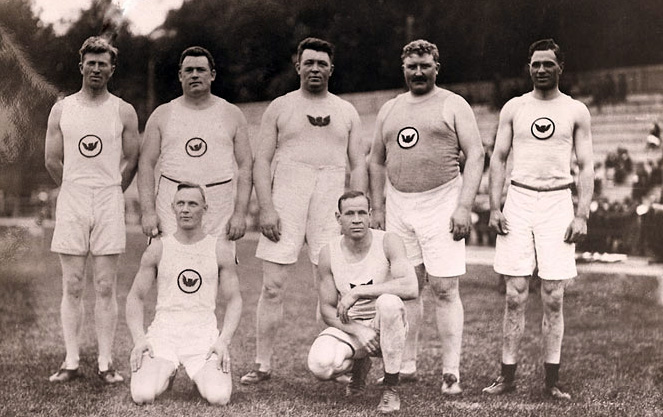
One elite group among the Irish medal collectors at the time were weight-throwers. Dubbed “The Irish Whales” seven athletes of Irish origin, competing for the USA won a total of 18 medals on the field (10 golds, 5 silvers and 3 bronzes). They were athletes of the two aforementioned famous athletics clubs of New York, while most of them were in the police force of the city as well. John Flanagan was the most decorated Whale with three gold medals in hammer throw at the Olympics of 1900, 1904 and 1908 as well as a silver medal in weight throw in 1904 St. Louis. Born in county Limerick in 1868, Flanagan moved to the USA in 1896 as a world record holder in hammer throw. He also set the Olympic record twice in 1904 and 1908.
Martin Sheridan of county Mayo was a close second behind Flanagan with three gold medals in discus throw and Greek discus and a bronze in standing long jump. Moreover, Sheridan won two gold medals in discus throw and shot put and three silver medals in standing high jump, standing long jump and stone throw at the 1906 Intercalated Games in Athens. A staunch supporter of the Irish cause, Sheridan died in 1918 in the early days of the Spanish flu pandemic.
Pat McDonald and Matt McGrath followed suit with three medals each. McDonald won one gold medal and a silver medal at the 1912 Stockholm Olympics in shot put and two-handed shot put respectively, and another gold at the 1920 Antwerp Games in 56 lb weight throw. McGrath won a gold and two silver medals in hammer throw and his Olympic record of 54.74 in 1912 stood for 24 years.
James Mitchel was another Whale, who won a bronze medal in 56 lb weight throw in 1904 St Louis. Patrick Ryan, who won a gold in hammer throw and a silver medal in 56 lb weight throw at the 1920 Antwerp Games, was also the first ever IAAF record holder, who set the world record in 1913 with a throw of 57.77m.
THE IRISH LEGACY IN THE US ATHLETICS
Irish American athletes collected medals on the track as well, with Patrick Flynn of county Cork winning the silver at the 3000m steeplechase at the 1920 Olympics after coming back from injuries sustained during the First World War, and Johnny Hayes who won the marathon gold in London at the 1908 Olympics, after Dorando Pietri of Italy was disqualified due to being helped up by the umpires after falling down because of extreme fatigue and dehydration. Hayes’s victory, which came at the first marathon race to be held at the contemporary standard distance of 42.195 km, helped establishing the tradition of long-distance running in the USA.
All in all, Irish athletes held a distinct place at the USA delegations during the early 20th century, up until the establishment of the Irish Free State, which helped Irish athletes to compete for their own NOC. The Irish athletes competing for the USA were such a powerhouse that they won a big proportion of the medals won by America during that period. For instance, Irish athletes won 10 of the 23 gold medals that the USA obtained in the 1908 Summer Olympics in London, a tally which would earn them the third place in the medals table, had Ireland competed under its own NOC. Athletics held a unique spot in this legacy with elite throwers, as well as talented runners and jumpers.