By Yavuz YAVUZ in Dublin
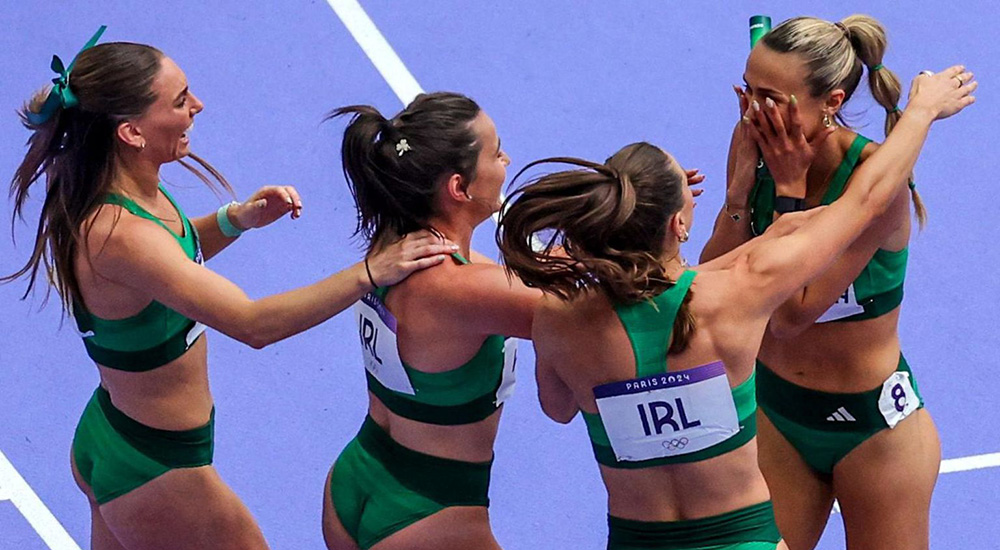
It is often said that coming fourth at the Olympics is worse than coming last. It’s the edge of the podium, so close to a medal yet so far. Thomas Barr even once said it left the athlete with “nothing to show for”, after finishing fourth in the men’s 400 metres hurdles race at the 2016 Summer Olympics in Rio. Surely a similar frustration was what Ireland’s women’s 4x400 relay team felt immediately after the final at Paris 2024. As bittersweet as missing so closely out on a medal may feel, however, the team had a lot to show for. First of all, they showed the strength and depth of the 400-meter runners in Ireland and their potential. They also showed – for the umpteenth time this year, perhaps – that they are perfectly capable of running in harmony as a team.
Ireland’s improvement in sprints has been on the forefront of the world stage for a while now, particularly with the rising global star, Rhasidat Adeleke. While the 22-year-old runner, who already has world and Olympics fourth place finishes in her career, was raised in Tallaght, the drive for sprint success has been flourishing in multiple places in Ireland. Dublin Sprint Group, which produced Olympic-level runners for more than 15 years, is one of them.
I met Gerard O’Donnell, one of the members of the group’s coaching team, and Sophie Becker, a runner of the group, in Dublin to get an insight of the phenomenon. O’Donnell is still a competing athlete who won his seventh national outdoor title in men’s 110 metres hurdles this year. Having joined the group in 2014, he talks about the impact of Jeremy Lyons, the founder of Dublin Sprint Group in his path en route to taking up coaching:
“Jeremy Lyons founded the group in 2008, and I wanted to be coached by Jeremy. I started working remotely with him for a year, then I moved to Dublin. I was a 400 metres hurdler at the time, Jeremy was a very good 400 metres hurdler as well. It kind of went from there. I was injured a lot – before I joined him anyway. Jeremy was like, ‘Maybe we could look at the short hurdles’ and we went on from there to the European Indoors in 2015. In 2019, Jeremy was affiliated with Dublin City University (DCU) but there were changes happening there. He decided to go separate as the coach of a professional group where he could make all the decisions. He asked me and Aideen Sinnott – a former hurdler – to come on board as coaches. He didn’t want me to retire as an athlete but take on more coaching responsibilities.
In general Jeremy does some planning, I take some technical stuff, Aideen is on the medical side but that pretty much changes week to week. In 2021, when we were getting ready for the Olympics I went away for a month with Sophie [Becker] and Cillin [Greene], and Jeremy told me to ‘do whatever I want’. He wanted me to decide for the plan that month. That was the first time I thought he had full trust in me as a coach.”
Dublin Sprint Group is organized in an unorthodox way, it’s not an athletics club nor does it have an established base. When asked about the structure of the group, O’Donnell says they are working to become a full-on high performance group:
“There are downsides such as the access to facilities and paying for the access. Still, it’s a training group in a truer sense, in the sense that it’s a group of people who want to work together towards the same goals. Since 2019, especially, we try to achieve a formal structure of a high-performance group. So, the plus side is we can do what we want, and what we want to do is to make it more formal, professional, and structured. We want things to be as proper as possible for the athletes and coaches.”
At this point, Sophie Becker weighs in to provide the athletes’ point of view of the group. Born and raised in Wexford, Becker tried various sports from Gaelic football and camogie to tennis and horse-riding. “Like any child that grew up in the Irish countryside in early 2000s, I was thrown into everything” she says. But eventually she landed in athletics, which proved fateful for her choice of university:
“In 2016, I had to decide where I was going to go to university. A few of my friends were in the DCU and were being coached by Jeremy at the time. That kind of helped making up my mind. I really liked studying genetics and cell biology there. There was also an athletics group there that I wanted to join, which specialized in the 400 metres. I honestly think that’s when my athletics career started to take off. I’m from a really small club in Wexford, it was perfect for what I needed at the time. But going to college, I realized the big world out there with the opportunities. I finally had really good facilities. I really think I saw an improvement in my racing when I joined the group. At the time, Jeremy was the sole coach and there was a really good group of girls who were the same age and doing the same distances. It was the perfect setup for me to get into athletics more seriously.”
400-METRE FEVER
The conversation turns to how the 400-meter running improved in Ireland and reached its current state. For Gerard O’Donnell, the shift towards the 400-metre has a lot to do with the material conditions in Ireland:
“I suppose Derval [O’Rourke], Paul [Hession], who just missed the men’s 200 metres Olympic final in Beijing 2008, and David Gillick as well who probably should have won the European title in 400 metres were role models for the sprinters. Then came Thomas Barr, at a time when all these athletes were retiring, and showed that people could really win world-class accolades again. There was this atmosphere that gravitated towards the 400 metres in Ireland because of the weather and facilities being best suited for the distance. I suppose the weather here doesn’t really allow for intense training. So, everyone thought that we could get by on the 400-metre lap of the track, because it’s a more adjusted space. We can do it in the rain, in the cold. But now that we have two proper indoor tracks, you see the short sprints moving on as well.”
Sophie Becker, furthermore, underlines the impact of Phil Healy of West Cork, the former Irish record holder in 100 and 200 metres: “I think a lot of the drive for women’s 400 metres in Ireland is due to Phil Healy, she spearheaded it. I suppose everyone knows her “depths of hell” run video from the anchor leg of the women’s 4x400 metres at the Irish University Championships in 2016 with University College Cork. From that moment on women’s 400 meters started to improve crazy fast. It’s nice to have been around since the start of the 400 metres era to where we are now.”
O’Donnell, having worked closely with Healy and her coach, Shane McCormack, agrees: “We’ve always looked up to Phil anyway, she was the one who broke through, 53 seconds was the magic barrier in Ireland, and she ran 51 seconds. So, I suppose it was always kind of the case of trying to be like Phil, for the guys and the girls.”
BEHIND CLOSED DOORS
The pandemic was a challenging time for the group, since with the lockdowns, they dispersed all around the country. “We tried to make sure everybody was doing the same session in different ways. I was doing the session on grass, Sophie was doing it on gravel, Cillin was on the road…” says, O’Donnell.
Becker remembers the time with the trips they made to Navan, Co. Meath for training: “The track, it wasn’t the best. It was cold and raining. Access to facilities was the hardest part but so was getting races and going to training camps – especially abroad. But during the pandemic, we realised we don’t always need a track for sessions. We don’t use a track for every one of our sessions since then.”
The second year of the pandemic brought two members of the group, Sophie Becker and Cillin Greene, to the Olympic scene. Alongside Phil Healy and Christopher O’Donnell, they carved their names into history by making the Olympic final in mixed relay, in Tokyo. For Becker, it was an informative experience: “There was this crazy excitement over the fact that we were the first relay team to make an Olympic final and a global final since 2004 (when the men’s 4x400 team won bronze in World Athletics Indoor Championships). I think it was a really good learning curve – definitely for myself anyway. Just even navigating through how to run a-heat-and-a-final race. It was also my first time on the world stage at that level.”
Gerard O’Donnell, on the other hand, recalls how the mixed relay final helped them build on the experience to qualify three athletes to the individual 400 metres race at Paris 2024:
“We knew Ireland was at that level, if you have two or three athletes on the men’s side and two or three on the women’s side, an opportunity emerges for those guys to get to the Olympics.
Obviously, we want them to get there individually too but running the relay also brings experience. Cillin ran the fastest leg off the blocks in the whole Olympics with 45.15 – and his PB was only around 46.10. So, this gives them an eye-opener that there aren’t aliens out there. Their performances have the same effect on athletes on the bench or at home as well. So, with relay races you get in the door, you show what you’re made of, and you step up, step up, step up.”
IRELAND FINALLY BREAKS THROUGH
The fruits of the Olympic Games in Tokyo were quick to show themselves, especially for Becker. In what she calls a snowball effect of the Olympics, she ran faster than 53 seconds for the first time and qualified for her first World Championships the next year. In Eugene, she missed out on the semi-final by just 0.07 seconds. A major breakthrough for her and the Irish team, however, came at the European Championships later that year. As the women’s team ran in the final in Munich, they also broke the 11-year-old national record with 3:26.06. For Sophie, it marked the first time she ran the opening leg in women’s relay races – which still continues to this day:
“I ended up as the first leg runner because I got the shortest straw. Nobody likes running first! For a lot of reasons; the pressure, the splits being slower because you begin from the blocks… But I did it, I don’t usually mind, I take whatever and give it all. I started getting comfortable with it, and now I like the first leg. I’ll fight somebody if they try to take it away from me! I’m confident in my start and in getting everybody off to a good start.”
At the 2023 World Championships in Budapest, Irish mixed and women’s 4x400 teams were in the final once again, cementing the program’s place as a constant in major finals. O’Donnell observed this in the busy year of 2024 when they began with the World Relays in Bahamas with Olympic berths on the line:
“This affected how other teams perceive us as well, particularly because we have Rhasidat – she is a global star. Other teams are now thinking ‘Ireland are here, we’re in trouble’. Even in the Bahamas, when Thomas Barr went out to the track, Femke Bol wished him good luck but then said ‘Actually, not too much luck’. He was like, ‘That’s great!’
Ireland’s relay teams were crowned as medallists at the 2024 European Championships in Rome, with the mixed team winning the country’s first continental gold medal in 26 years while the women’s team trailed behind Femke Bol’s The Netherlands for a silver medal. While this boosted the athletes’ confidence for the Olympic Games, the mixed team kicked off Ireland’s campaign in Paris by falling in the heats. However, the women’s team ensured a confidence boost by qualifying for the women’s final, which was held the day after Rhasidat Adeleke became the first ever Irish sprinter to run a flat final at the Olympic Games and came fourth. For Sophie Becker, the team knew deep inside that something big was brewing on the day of the final:
“We didn’t have Rhasidat in the heat, Kelly McGrory ran in her place. Every single one of the girls ran great legs and we comfortably got to the final. Then we started thinking about the possibilities. We had a meeting in the morning of the final and our relay coach, David McCarthy, asked us our goal. We all looked at each other because at the back of our heads we all knew a medal was very within reach. But we didn’t actually want to say it, so we said, ‘Let’s go for a national record’. We were thinking of sub-3:21.00 but I don’t think any one of us thought of 3:19.90.
It was a magical race; I just remember handing the baton to Rhasidat and just still having the energy to shout ‘Go!’ at her and then to watch the race unfold – from the best seat in the house! It was amazing to watch us staying in the third place for so long, but then Femke Bol just comes along and, you know, what can we do? It’s bittersweet but still, finishing fourth at the Olympics, it’s incredible.”
WHAT THE FUTURE HOLDS
Sophie Becker is one of the two members of the relay team – alongside Phil Healy who is a software engineer – who work day jobs. Working at Pfizer, she says she will consider her work/training schedule:
“They were kind enough to give me a sabbatical back in March and I immediately saw the benefits of it. So, I’m weighing my options: do I turn a full-time athlete or maintain the work/training balance? I’m so close to breaking the 51-second barrier and I’ll be looking at that as well. Maintaining my spot in the relay team is another goal, that’s the beauty of this – there are girls who are pushing to have their turn on the relay. If I can make individual championships, I think it goes hand in hand with keeping my spot on the relay teams.”
According to O’Donnell, among the group’s priorities now will be looking for ways of staying competitive in the global stage: “We’re going to have to look back to what we did well this year as well as things that we can do differently – for getting better results or for getting the same results but with littler effort. We’re going to keep pushing to try and bring the floor up to meet the ceiling – which is always going up, so we need to raise the floor at the same time.”