
Text by Yavuz YAVUZ
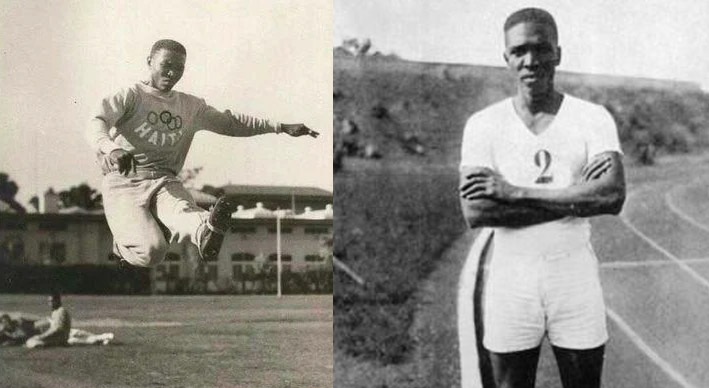
Winner of one of the two Haitian Olympic medals and the country’s sole athletics medallist, Silvio Cator was born in 1900 in Cavaillon. He took up a variety of sports including football and tennis alongside athletics. In fact, his sporting interests were largely shaped under the occupation of the United States forces which began in 1915 when he was fourteen. While some historians link the training with the marines to the athletic development of Cator, the Haitian often expressed disdain over the occupation and even refused to play baseball as protest over the U.S. occupation. What was really influential in his sporting life, according to his own account, was training at the hills around the capital, Port-au-Prince.
In 1924 this training paid off with an Olympic debut in Paris, where he took part in the high jump and long jump races, which he finished 15th and 12th respectively. He won a silver medal at the long jump race of the 1928 Summer Olympics in Amsterdam with a 7.58 jump, right behind America’s Edward Hamm. A month later, Silvio Cator sent shockwaves around the world with a 7.93m jump at the Stade Olympique Yves-du-Manoir in Paris. He broke the world record set by Ed Hamm two months ago, as well as setting a distance that is, to this day, yet to be overcome by any other Haitian athlete.
Some records indicate that in 1929, Cator became the first athlete to jump beyond 8 meters with a distance of 8.04m, however, there is very little evidence about this jump and there is a strong chance that the jump was supported by a heavy back wind.
Starting from 1930 onwards, Cator turned his attention to politics, becoming vocally engaged with the anti-occupation student movement in Haiti. He began taking up different roles such as being the head of the Haitian Sports Federation and a journalist at the United Press.
In 1932, Cator returned to the Olympic arena for a final time -where he was placed 9th in the long jump race- only to be met with racism and hostility. The Haitian responded by engaging with the black community and appearing in black press. Despite being reluctant to talk about the Jim Crow laws raging in the United States at the time due to concerns about pushback, in an interview with the Chicago Defender as cited by Dr. Brandon R. Byrd, he predicted that the Olympics would not be held in the U.S. again for a long while and even if it did he would not take part in them.
In 1946 Silvio Cator was elected as the mayor of Port-au-Prince. He died in 1952 and a stadium was opened shortly after, bearing his name. After all, what really mattered beyond his record and silver medal was the struggle that he was part of.