By Yavuz Yavuz in Tokyo National Stadium
The morning session returned with 20km race walk finals, which saw Marta Perez of Spain complete the Tokyo double after her triumph over 35km last weekend, and Brazil’s Caio Bonfim go one step up compared to his previous podium place last week.
In the women’s race, Marta Perez clocked 1:25:54 and achieved her second world double after Budapest 2023. Former world junior champion Alegna Gonzalez of Mexico walked a North America record of 1:26:06 to win silver — the first race walk podium of her country in eight years — and Nanako Fujii, despite making a contact foul twice, won Japan’s second medal at the championships by setting a national record at 1:26:18 to win bronze. Kimberly Leon, Peru’s double world champion of Eugene 2022, stopped the clock at 1:26:22, a new Peruvian record, but settled for fifth place.
On the men’s side Caio Bonfim, Olympic silver medallist of Brazil, won his first ever world title in 1:18:35, in the fourth podium of his career. Asian champion Wang Zhaozhao won silver, whereas Spain’s Paul McGrath came in third.
RELAY CHAOS
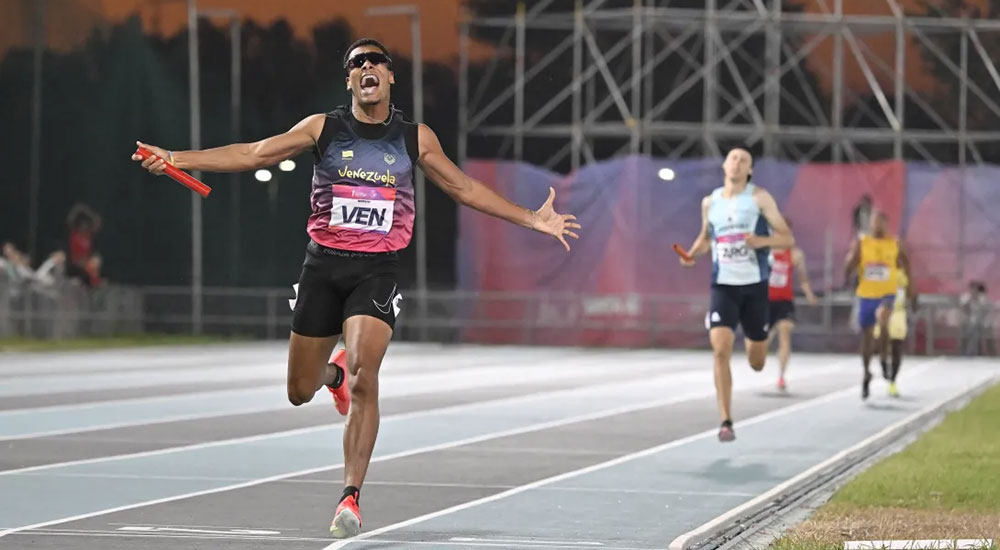
The heats of 4x400 and 4x100 relay races became stage to some chaotic exercises. In men’s 4x400, USA finished sixth in their heat and for a moment were thought to have missed out on the final — a first in history for the 12-time champions. But Zambian team found to have committed an infringement that impeded both USA and Kenya and was disqualified. The two teams were granted a run-off that will determine who would get the ninth lane in the final.
Men’s 4x100 was no less hectic as Jamaica, Olympic bronze medallist Britain, South Africa and Italy, who had Lamont Marcell Jacobs — the men’s 100m winner of the Tokyo Olympics — in their line-up, all failed to finish their heats. Team Jamaica, who went 1-2 in men’s 100m failed to pass the baton to Kishane Thompson for the individual silver-medallist to anchor and produced the greatest shock. South Africa, World Relays champion and Olympic silver medallists, was later given a solitary rerun on the grounds that they were impeded by Italy. They will need a 38.34 finish to make the final.
Ghana, the African champions anchored by Abdulrasheed Saminu, set a new national record of 37.79 to top their heat while Japan also stormed to the final coming in third in the heats, with a huge crowd support behind them. In women’s 4x400, Spain, the World Relays titlists, and Britain could not make the final.
ANGULO’S NIGHT
In women’s javelin throw, Ecuador’s Yuleisy Angulo set yet another national record with 65.12, which was enough for her to win gold, her country’s first ever field medal, as well as first non-race-walking medal in six years. The country’s first world finalist at a field event also became its first gold medallist in a women’s competition at the world championships. Anete Sietina of Latvia was eighth coming into fifth attempts but catapulted herself to second place with a throw of 64.64 and held on to silver. Fourth in Budapest two years ago, Sietina won Latvia’s first world medal in a decade — and third overall. While McKenzie Little’s first attempt of 63.58 was enough to put her on podium with a bronze, she continued the Australian streak of medalling in the event for the fourth consecutive champs.
In the meantime, both of the Balkan stars, Adriana Vilagos and Elina Tzengko failed to medal, despite Sofia Sakarova, Greek-Palestinian politician and former European medallist javelin thrower, supporting the latter on the stands.
In women’s shot put, Jessica Schilder finally won the first world title of her career by jumping from fifth to first place at her last attempt with a throw of 20.29. Schilder became the first European athlete in a decade to win gold medal in the event, as well as the first Dutch. Chase Jackson, champion of the last two editions, jumped from fourth to silver place at her last attempt as well by throwing to 20.21 metres, whereas Maddison Lee-Wesche won New Zealand’s third medal by equalling her own personal best at 20.06 for bronze.
Olympic champion Yemisi Ogunleye of Germany and former world champion Lijiao Gong could not find 20 metres in their throws.
THE CHEBET DOUBLE
With a gold medal in women’s 5000m, Beatrice Chebet repeated the double she pulled in Paris 2024 a week after her 10,000m gold, and became the third woman to do that at the world championships after Tirunesh Dibaba in 2005 and Vivian Cheruiyot in 2011.
In the last couple of laps Nadia Battocletti took the lead before Chebet and 1500m gold medallist Faith Kipyegon kicked to drop her. Chebet finished in 14:54.36, Kipyegon crossed the line at 14:55.07, and Battocletti claimed her second medal in Tokyo with a bronze in 14:55.42.
In women’s heptathlon, Anna Hall became the first US representative to claim gold since Jackie Joyner-Kersee in 1993 with 6888 points. Setting a PB in both throws, Hall managed to pull ahead of the rest of the pack. Kate O’Connor made history for Ireland by being the first ever multi-eventer to medal at the worlds, as well as winning the country's first world medal in 12 years. With 6714, she also set a new national record.
For the first time in history, two athletes were tied for bronze medal at heptathlon, with Taaliyah Brooks of the USA and defending champion Katarina Johnson-Thompson locking horns at 6581 points and sharing the medal.
OLYMPIC DÉJA VU
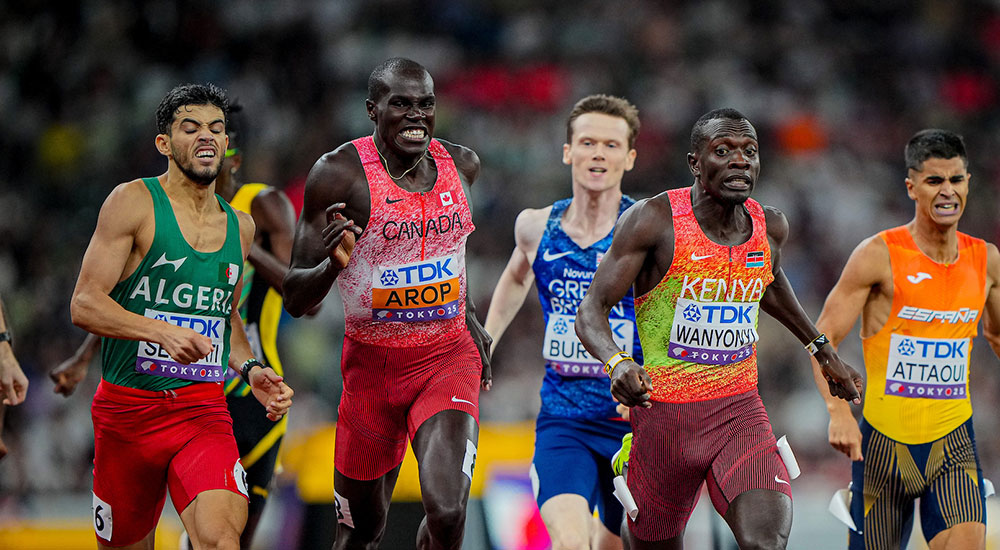
Olympic medallists of men’s 800m were once again on the podium. In a very deep race that saw all eight finalists run under 1:43, Kenya’s Emmanuel Wanyonyi set a new championship record at 1:41.86 and won his first world title. Djamel Sedjati came a close second in 1:41.90 and defending champion Marco Arop settled for bronze in 1:41.95.
Ireland’s surprise finalist Cian McPhillips pushed real hard for a medal climbing from eighth place to fourth in the last 100 metres and set a new national record at 1:42.15.