By Luis Vinker*
More than four decades [now five decades] have passed, and her national 200-meter record of 22.94 seconds — which also stood for a long time as the South American record — remains untouched. It is the oldest individual mark on Argentina’s women’s all-time list and, for now, seems unreachable. For Beatriz Allocco, the greatest sprinter in Argentine history, it was “a dream performance,” achieved at altitude in La Paz during the first edition of the South American Games, which at that time were called the “Cruz del Sur” Games.
But although that was the mark, it was only one chapter among her many great performances that made her the most important Argentine athlete of that decade. She dominated South American sprinting with all her titles in 1977 and 1979, and what remained as unfinished business — for various reasons — was the Olympic appearance she had so longed for.
Beatriz Eva Allocco was born in Buenos Aires on April 12, 1955, and came to athletics after family and friends encouraged her, having seen her run around her Villa Celina neighbourhood. She was just thirteen when she began training at the Parque Chacabuco track under the guidance of the great coach Francisco “Pancho” Mura, who led the Luz y Fuerza Institute program. Beatriz and her family formed one of the most beloved “teams” of that era; her father Walter even helped as an anemometer operator at local meets.
Although she quickly stood out for her abilities in several events, the leading figure of her generation was Irene Fitzner (later the mother of Jennifer Dahlgren), who broke the national 100-meter record at just fifteen. Irene and Beatriz shared numerous FAM and national teams during those years and built great successes in the relays, from youth to senior levels. Irene excelled in the 100 meters (and sometimes the 200), while Beatriz competed in several events until sprinting definitively captured her.
At the 1969 National Youth Championships in Córdoba, Allocco won the high jump and the short relay, and also finished fourth in the 100 meters and fifth in the hurdles (then run over 64 meters). A year later in Lomas de Zamora, she retained her high jump and relay titles.
During the 1970 season, she was part of the memorable team that won the South American Juniors in Cali, where she finished just one tenth behind Fitzner in the 200 meters (25.2 to 25.3) and shared victory in the short relay with 47.9 seconds — excellent for the time — alongside two promising GEBA athletes, Alicia Masuccio and Patricia Morone. In 1971, at just sixteen, Allocco joined the national team for the Pan American Games in Cali, reaching the semifinals of the 100 meters and finishing seventh in the relay, which set a new national record of 46.72. Shortly thereafter, she won her first senior South American title in Lima, when the relay team — with Cragno, Godoy, Allocco, and Fitzner — claimed gold in a hand-timed 46.7. It was also the last time an Argentine women’s team topped the overall standings at a South American Championship; Brazil has been unbeatable since.
A few months later, in early 1972, Beatriz suffered the loss of Don Pancho. “It was a huge blow for me and for our whole team… I stayed away from athletics for three months until I decided to return and we began training with Guillermo Padial,” she recalled.
HUGE SUCCESS
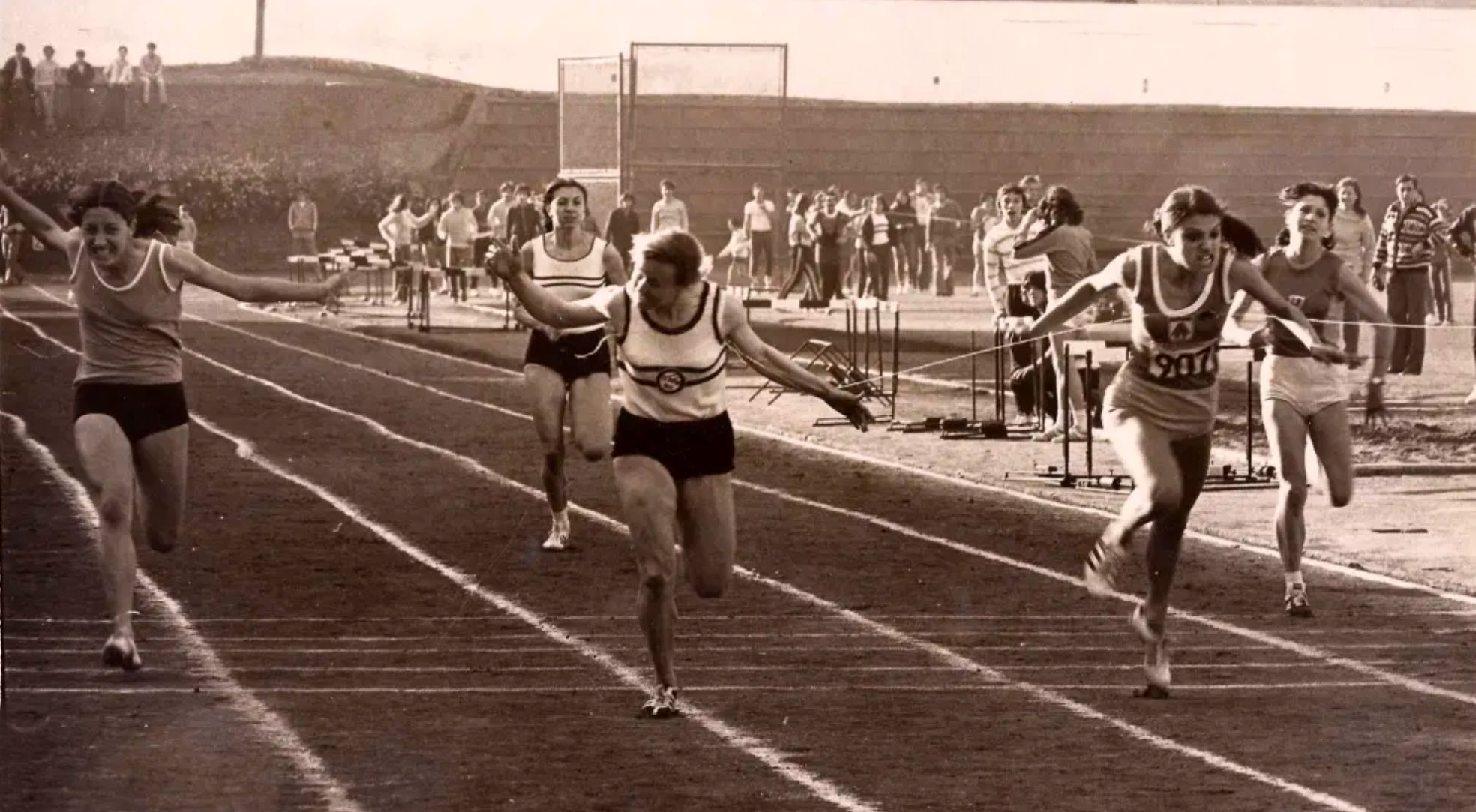
Her major breakthrough came in 1973, when she emerged at the forefront of a strong generation of Argentine sprinters that included Liliana Cragno and Rosa Godoy (both from Atlético Olimpia) and Córdoba’s Belkys Fava. After dominating sprint events at the 1972 and 1973 National Junior Championships, Allocco made her first major impact at senior level by setting a national record of 24.3 in the 200 meters at the National Championships inaugurating the Mar del Plata stadium track in September 1973. Unforgettable races were seen there. Cragno won the 100 meters in 12.3, tied with Fitzner and with Allocco just a tenth behind. But in the 200 — which would become Allocco’s signature event — her 24.3 broke the Argentine record, one tenth ahead of Godoy, with Cragno third in 24.9 — a collective level that was surprising for that time.
From then on, she was the number one sprinter. She went on to represent other clubs such as Agrupación Atlética Aconcagua and later River, working under the respected coach Enrique Eleussipi.
In 1975 she competed at the South American Championships in Rio de Janeiro, when regional sprinting was still dominated by the talented Silvina das Graças Pereira. Allocco earned silver in the 200 and bronze in the 100 but triumphed again in the relay, where alongside Fava, Godoy, and Cragno they clocked 45.9. Months later, that same team placed fifth at the Pan American Games in Mexico with 44.90, another national record that has remained unbeaten ever since. Individually, Allocco reached the semifinals in both the 100 and 200 at those Games. It was not enough for her to be named to the Olympic team for Montreal the following year, which caused one of her greatest disappointments.
LACK OF SUPPORT
They were very difficult years. The dictatorship was already in place; Argentina’s top athletes received almost no support, had no synthetic tracks, and faced very limited international competition opportunities. But Allocco maintained her progress and, at the end of 1977, became one of the standout figures at the South American Championships in Montevideo. She won the 100 meters in 11.97, achieving a 1-2 finish with the then-junior Beatriz Capotosto (later Argentina’s best hurdler). Allocco added victories in the 200 (24.7) and the short relay, now formed with Capotosto, Santa Fe’s Susana Perizzotti, and La Plata’s Araceli Bruschini, a long jump specialist.
In 1978, Allocco had the opportunity to train and compete in Spain, where she also began to focus more seriously on the 400 meters, lowering the national record to 54.5. “Now I’m convinced it could be my specialty… But I feel comfortable in the 200. And I like the 100 meters,” she said upon returning. It had been an eye-opening experience: “I was able to train on a synthetic track, had weight rooms and equipment, all the facilities,” she explained — something out of reach for Argentine athletes at the time.
Allocco was already running under 24 seconds in the 200 — she had clocked 23.70 in the World Cup qualifying heats in Guadalajara — but the altitude of La Paz offered new possibilities. Even so, her 22.94 seemed almost unbelievable at the time, placing her close to world-class levels in the event. Although it was the highest track in the world and the races were held with no wind, her expectation had simply been to approach 23 seconds. Just before, the men’s 200 meters had been won by Chile’s Luis Schneider, and there had been a failure in the electronic timing (20.50 was initially shown for the winner, but manual watches later revealed a one-second difference). That did not happen in the women’s race, where manual timing confirmed the excellent marks of Allocco and runner-up Carmela Bolívar of Peru, allowing for official ratification.
MARRED BY THE 1980 BOYCOTT
Those performances at the first South American Games — where she also won the 100 meters in 11.73 and the short relay alongside Bruschini, “Mili” Dyrzka, and Yvonne Neddermann — became her platform for 1979, the final season of her career, when her focus was on the Pan American Games in Puerto Rico. There she had the opportunity to compete alongside major world stars and reached the 200-meter final, finishing eighth in 23.99w. The winner was American Evelyn Ashford — the world’s best that season — with 22.24, followed by Canada’s Angela Taylor in 22.74. Jamaican legend Merlene Ottey took bronze in 22.79, five hundredths ahead of future Olympic 400-meter champion Valerie Brisco-Hooks.
Months later, at the South American Championships in Bucaramanga, which marked her farewell to competition, Allocco reaffirmed her titles in the 100 (11.7), 200 (23.5), and the relay, this time with Marisol Besada, Fava, and Neddermann.
She retired very young, never had another Olympic opportunity (the leadership of the time joined the boycott of Moscow 1980), and went on to work in physical preparation and youth athletics coaching. For the past decade, she has lived in Miami, where she and her husband Pablo Barreiro — they have three children — run real estate activities. She has received tributes and recognition for her outstanding athletic career, most recently honored by FAM last July when it paid tribute to the “athletes of the century.”
* The original Spanish piece was initially published for the website of Argentinian Athletics Federation (CADA) on 6 June 2020.