By Yavuz YAVUZ
Seb Coe’s recent experiment of filling the only calendar year in Olympic cycle without a global major championship concluded after a three-day shindig in Budapest. World Athletics Ultimate Championships, a downsized version of a major championships brought together the best athletes of the cycle with a results-based qualification system from the most recent Olympic Games, World Championships, and Diamond League circuit, as well as season rankings.
The inaugural World Athletics Ultimate Championships were hailed as a success across the World Athletics feed, as well as by a considerable portion of the international media that covered the event. Still, it is almost impossible to overlook the elements that need improvement, and the death knells that the need to construct this format ring for the future of global athletics.
A TECH GIANT OF AN EVENT
Even though the stated aim of this event was to crown the ‘best of the best,’ the championships were headlined by technological prowess rather than outstanding marks. Most positive outcome of the event was the use of broadcast-friendly technology that gave a more clear and detailed view of the action – particularly in the field events. The drone cameras that follow the javelins, virtual zoning in horizontal jumps and the track locator in running events carry the potential to familiarize more viewers to the sport by allowing them to follow the action in a more comprehensible fashion.
In a world where football is carving up a major slice of the pie that is the sources governing bodies for various sports have access to, drawing engagement through focusing on the action itself rather than entertainment pertaining to symptoms of attention-deficit disorder is one that should be written on the pros column of the event.
DOWNSIDES OF THE PARTY
Still, TV technology dominating the plus sides of the event signal a bigger issue surrounding the sport. World Athletics Ultimate Championships were, ultimately, a TV-event. That is not to take away from the seemingly impeccable hosting Budapest put together but to highlight how it reduces from the field for the sake of broadcast revenue.
The Ultimate Championships were organized in a scaled back manner, with the downsize being made by including only 28 events with substantial omissions of steeplechases, 10,000 metres, shot puts, discus throws, men’s triple jump and women’s hammer throw. The events being choked from the program signals a clear choice. These events are not TV-competent, and the World Athletics made it clear it is their view that they cause the audience to switch channels. This sparked significant backlash from the track and field community with Matthew Denny, Olympic bronze-medallist discus thrower, railing against the omission of his event in one of the most outspoken decries against the format:
“When events are minimally shown on broadcasts for the last 20 years, you lose the reasoning to say people don't want to watch. You cannot control what gets shown, what gets promoted, whose stories are told, and which events receive the greatest exposure, then simply point to the result numbers as proof that people do not care about everything else.”
This preference of some events over others was also clear in the landscape, with colours of the stadium specifically designed to highlight the track and move the attention away from the field.
Another novelty that bugged the eye was the predicted finishes shown before any race, demonstrating the possible place of the athlete at the end through an algorithm of season bests and performances in the run up to the event. They did not only crash spectacularly at times, as in the case of Jakob Ingebrigtsen who topped a very strong men’s 5000m field after the graphic guessed a 13th place finish for him, but they also moved focus away from diverging parameters of success that define each athlete’s target performance by reducing them to their place at the end.
A STAR-STUDDED FIELD DELIVERS
On the field, some significant marks headlined the inaugural World Athletics Ultimate Championships. Melissa Jefferson-Wooden showed Flo-Jo’s women’s 100-200 world records are now seriously on borrowed time by clocking 10.62 and 21.47, respectively, with the latter being the third-fastest time ever.
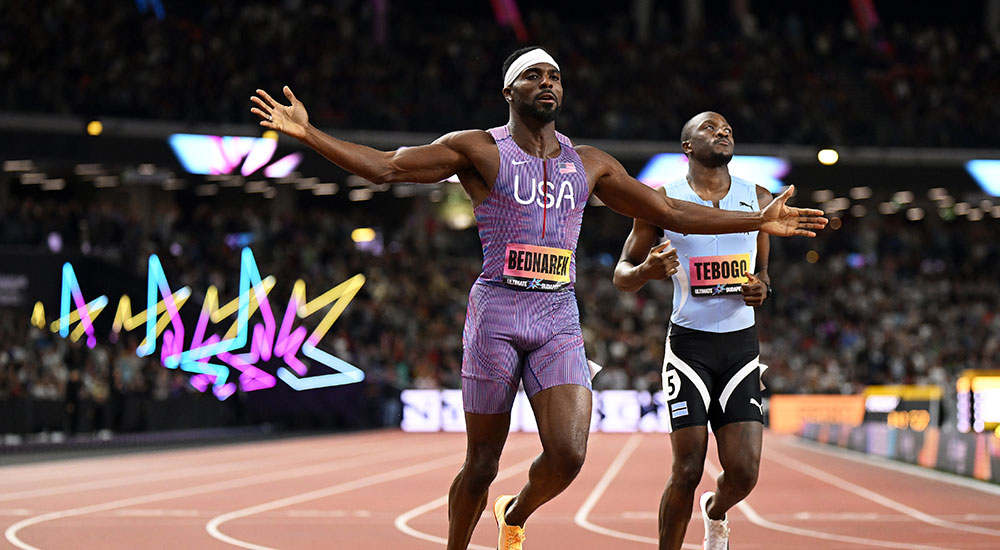
Collen Kebinatshipi of Botswana topped the men’s 400m field with a time of 43.39, fifth-fastest ever, continuing to improve on his stellar season even at its end. In men’s 400m hurdles Alison dos Santos, who grabbed the world record this season from Karsten Warholm, set yet another sub-46 time by stopping the clock at 45.98. His jog at the final stretch showed there is certainly more to see in his legs in the coming season.
Gianmarco Tamberi, the European champion in men’s high jump, soared to an astonishing 2.37 metres in what seemed to be one of his most comfortable races in a long time and set a resounding world leading mark. Sally Sarr of Senegal was crowned the women’s triple jump Ultimate champion with a leap of 15.06 metres, world record holder Masai Russell edged Tobi Amusan and Nadine Visser in 12.22 seconds in women’s 100m hurdles, and Audrey Werro overpowered Keely Hodgkinson and Femke Broeders-Bol once more this season in 1:55.88 – a modest time considering the multiple 800 metres she ran under 1:54 this year.
In Javelin throw, Japan’s Olympic champion Haruka Kitaguchi set a massive national record of 68.92, claiming the Ultimate title over Yan Ziyi, the Chinese sensation who blasted a 71.74 earlier this season. On the men’s side, Sri Lanka’s Rumesh Tharanga Pathirage threw yet another javelin beyond the 90-metre line, claiming the title with 91.09 metres.
WHAT THE FUTURE HOLDS
Different sports across the world are scrambling to draw sponsor money by filling up calendars with major championships. Some opt for biennial cycles, moving away from quadrennial ones, others create new events altogether. World Athletics Ultimate Championships mark the newest specimen of the latter path. Although this could be viewed as a venture to garner attention to a sport that’s bleeding viewers, eventually what drives these quests is money which requires a constant circulation of action in the sport.
Ultimate Championships was the response of World Athletics in the face of challenges by Grand Slam Track – which went down in flames by filing for bankruptcy without completing its inaugural season – and Athlos. It should give us a clue as to where the sport is headed, that is a growing focus on track events that risk overshadowing field events and leaving field athletes behind. What is needed, then, is to integrate the positives of the event to improve the current structure and finding ways of supporting athletes who take part in sport as a whole, not separating them based on broadcasting preferences.