The beginnings of women’s journey onto the sporting stage date back nearly a century. When writer and activist Alice Milliat's efforts to persuade the International Olympic Committee (IOC) to include women’s athletics in the Olympic Games failed, she launched an alternative competition in 1921. The inaugural Women’s World Games brought female athletes from five European countries together in Monaco for a week. A year later, the first alternative women’s Olympics took place in Paris, with 77 athletes participating.
In the sociopolitical climate of the time, when women in some European countries did not even have the right to vote, participating in sport was far from easy. Nevertheless, Milliat and her colleagues' initiative paved the way for women to compete in athletics at the 1928 Amsterdam Olympics.
Athletics was the eighth sport on the Games’ main programme, following golf, tennis, equestrian, sailing, archery, skating, aquatics and fencing. Women competed in five athletics events in Amsterdam. Canada, which won four medals, drew the most attention during this historic debut.
In the high jump, 20-year-old Canadian Ethel Catherwood arrived in Amsterdam as the world record holder recognised by the International Women’s Sports Federation (FSFI). However, a month before the Games, Dutch athlete Carolina Gisolf took the record by clearing 1.60.7 metres at a Netherlands–Belgium dual meet in Maastricht. United States national champion Mildred Wiley also competed in Amsterdam, alongside the two favourites. The final, featuring 18 athletes, ultimately became a contest between these three.
Starting at 1.45 metres and clearing every height up to 1.58 on her first attempt, Catherwood was left competing alone. She then cleared 1.60 on her third attempt to win the gold medal. Under the rules of the time, however, her result was officially recorded as 1.59.5. Gisolf, the Dutch world record holder, won silver after beating Wiley in a jump-off, with both athletes having cleared 1.56 metres. Still young, Gisolf would return to the Olympic Games four years later, hoping to fulfil her lingering ambition of becoming champion. She arrived in Los Angeles in the summer after improving the world record to 1.62 metres, but finished fourth in the 1932 Olympic final.
The 100 metres began with 31 competitors and ended with a six-woman final featuring three Canadians. In the final, Myrtle Cook, who had set a world record of 12.0 seconds a month before the Games, was disqualified. American Betty Robinson won the title in 12.2 seconds, with two Canadians finishing behind her. Robinson had run her first official race just five months earlier and claimed Olympic gold only days before her seventeenth birthday.
Canada’s achievement of placing three athletes in the 100-metre final paid off in the relay. With Myrtle Cook, disqualified in the individual final, delivering a strong anchor-leg performance, Canada clocked 48.4 seconds, almost a full second faster than the 49.3-second record the team had set in the heats.
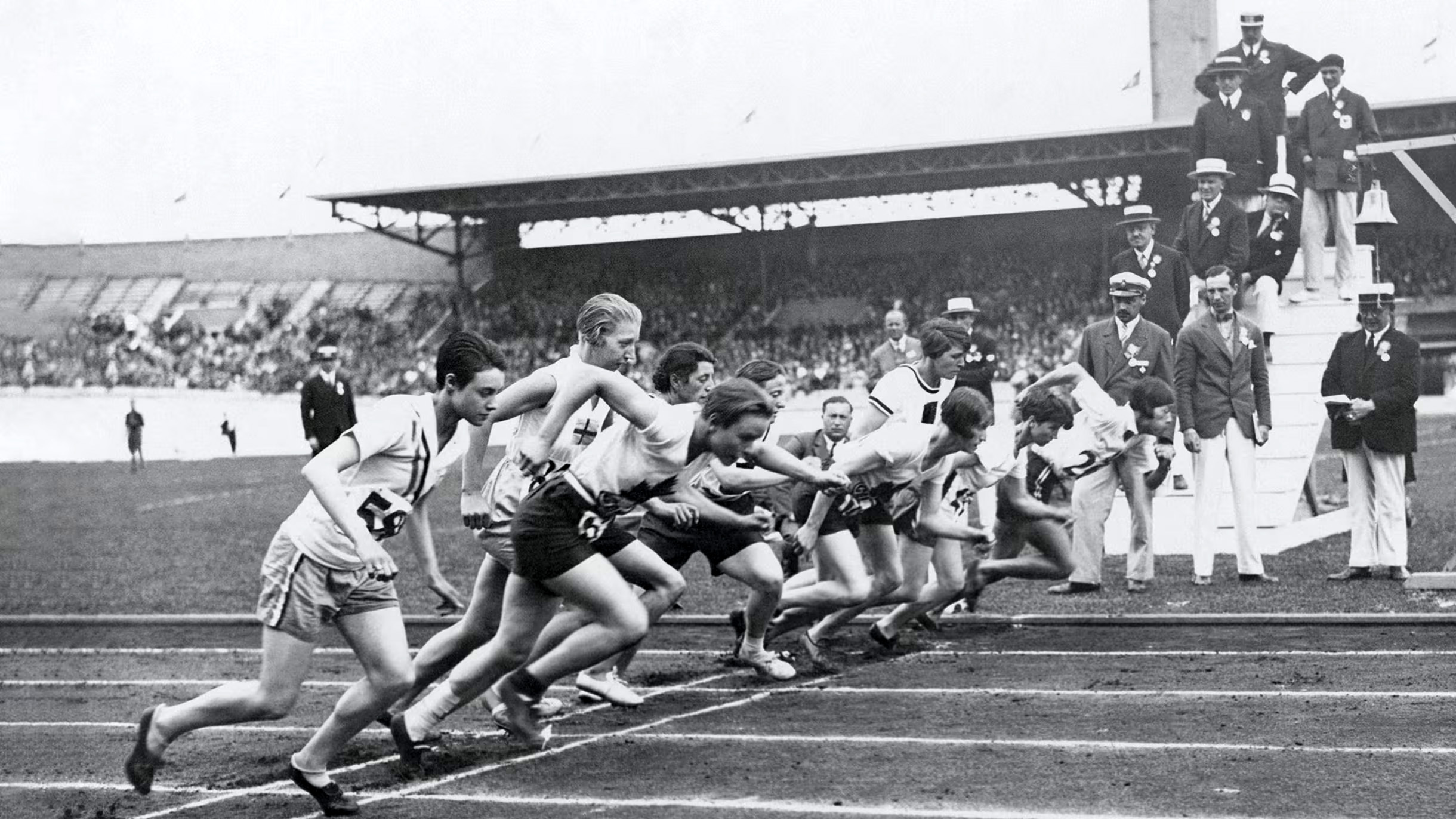
The much-discussed 800-metre event drew 32 registered entrants, but only 25 competed. Following three heats, the final was held the next day with nine athletes. The winner was Germany’s Lina Radke-Batschauer. Before arriving at the Games, Radke had become the first woman to break the 2:20 barrier in the 800 metres. She went on to set a new world record of 2:16.8 in the final, the third world record the 25-year-old German had set in a year.
Japan’s Kinue Hitomi, the country’s only female athlete at the Games, finished second. Having competed against European athletes before, 21-year-old Hitomi had won four medals at the Women’s World Games in Gothenburg two years earlier, where she had also set a world record in the long jump. Although she failed to advance beyond the heats in the 100 metres in Amsterdam, she exceeded expectations in the 800. Clocking 2:17.6, the Japanese athlete took second place ahead of former world record holder Inge Gentzel.
When the race ended, some of the athletes collapsed to the ground, struggling to catch their breath. Officials took time to get them back on their feet and ready for the next event. Yet, in some newspapers the following day, commentary claiming that women had been unable to finish the 800 metres and were unsuited to the distance dominated the coverage. As a result, the IOC would not allow women to compete in Olympic races longer than 200 metres until 1960.
In reality, all nine finalists completed the race, and seven ran faster than the world record set the previous year.
The Amsterdam programme's only women's field event was the discus throw. The favourite was Halina Konopacka, who had also won the 1926 Women’s Games. A versatile athlete, the Polish competitor arrived in Amsterdam having won national championships in four events that year.
Konopacka had already made her mark in the discus during the qualifying round, throwing 39.17 metres. In the final, she won with a world-record throw of 39.62 metres. Recognisable by the red beret she habitually wore in competition, Konopacka continued to win many of the events she entered until 1931 and became Polish champion 18 times across different disciplines. However, she never surpassed the world-record distance she set in Amsterdam.
Halina Konopacka later settled in Florida, where she spent the rest of her life. When she died in 1989, her ashes were brought back to Warsaw in accordance with her wishes and buried in the family cemetery.
Text - Athleticspodium.com