By Şevket F. ERBAY
Munich Olympics has been one of the chaotic games in history. It was dark-clouded after terror attack on Israeli Team, which electrified the atmosphere. On top of it, IOC was worrying about new protests such as 1968 Black Power, getting wind of something on US sprinters.
Before the 4x400 metres qualifying, two pivotal members of United States team, Vince Matthews and Wayne Collett banned from the competition after a ‘suspicious podium gesture’ during 400 metres ceremony. Additionally, John Smith was pulled out by hamstring injury while the American team left on three athletes: Maurice Peoples, Tommy Turner and 1968 Olympic champion Lee Evans – but they were unable to form a quartet.
By withdrawal of United States, 4x400 metres became very open for the rest of the field. The heats were contested on 9th of September with twenty-one teams. In the first heat, Great Britain and Kenya were through to final together after tight battle which separated by only 0.01 secs. The second heat won by European champions Germany and the last one was led by Polish quartet.
There were six European teams; Britain, France, Germany, Poland, Sweden and Finland, one Caribbean representative, Trinidad and Tobago and The Kenyans in the final start list on September 10.
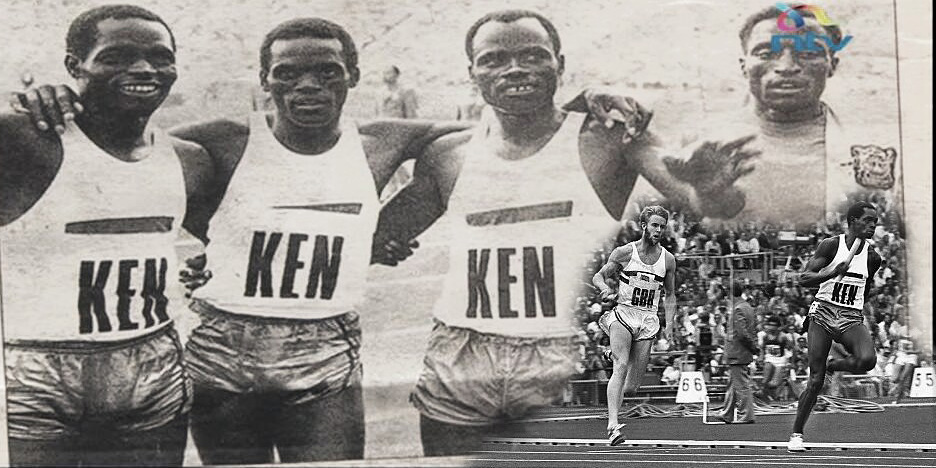
Kenya was under the radar before the final because their two members were well-placed at individual final three days ago. US-based Julius Sang secured a bronze medal ahead of team-mate Charles Asati, who was also at the silver-medal winning team in Mexico City Olympics. The East African quartet was exactly same as Commonwealth Games winning squad, only change for anchor leg: Asati was replaced by in-form Julius Sang.
Charles Asati led the Kenyan team early in the final such a good opening by 45.3 split and passed the baton to 30-year old Hezekiel Nyamau, another member of 1968 team. Nyamau was challenged fiercely by European rivals includes Britain’s hurdler Alan Pascoe and Olympic fifth-placed German Horst Schlöske. Even he stood in contention but completed relatively weak lap before the changeover to Robert Ouko, the third Kenyan runner. Ouko started slow but quickly picked up the momentum to stay in front-bench as turns his lap in 45.6.
When Julius Sang took the button from Ouko, Kenya was in fourth place behind Germany, France and Poland. European 400 metres record holder Karl Honz (44.72) was on the anchor for West Germans as well as Britons were on the push by David Jenkins. Meanwhile, Julius Sang who run his PB 44.92 in 400 metres final at Olympiastadion 72 hours ago, had some confidence too.
Sang waited for a while before pumping his pistons just after the final bend. He furiously past Honz from outside in 50 metres to go and break apart from the rest of the field by clocking massively 43.6 split – fastest lap in Munich 1972. When he was arriving at the finish line, other three members of the team jumped onto him to celebrate their historic win.
In the background of African celebration, Great Britain took the silver by 0.7 second margin, while Jacques Carette’s superb effort carried the French flag on the podium ahead of West Germans whose dropped “gold to nothing” in the final straight.
Perhaps, nothing can explain well this achievement like such a conclusion note: The Kenyans remained the sole Olympic gold-winning African relay team until the 21st century – only Nigeria repeated their success after United States doping disqualification from Sydney 2000 4x400 metres men’s final.
Nearly fifty years on, two members of the Eternal Team, Charles Asati and Hezekiel Nyamau were still alive. The other two are resting in the athletics heaven, peacefully.
Regardless, their inspirational run is continuing.
1972 Munich Olympics - 4x400 meters winning team:
KENYA 2:59.83
Charles Asati (split: 45.3), Hezekiel Munyoro Nyamau (45.8), Robert Ouko (45.2), Julius Sang (43.5)
VIDEO: THE HOME STRETCH ATTACK FROM JULIUS SANG