By Şevket F. ERBAY
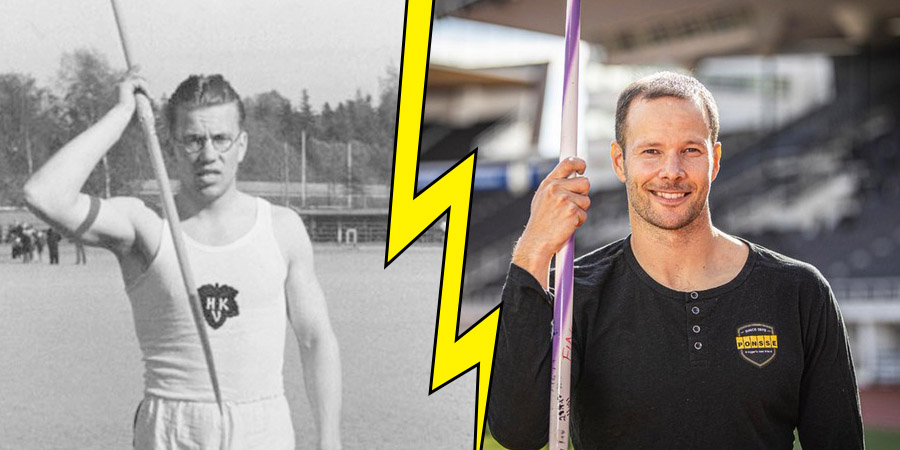
Javelin throw has long history back to the ancient Olympics. Despite missing in the early Olympic programmes until the 1908 Games, the speering masters have contested every Games since London.
Finland remembered for magnificent distance running greats at that time, has been enormously successful in javelin starting from the earliest competitions until today. They have won 25 Olympic medals – eight of them gold - and became the leading nation in javelin throw history by some means. Into the bargain, the Finnish athletes bagged lots of titles in other big scenes while securing five World, six European, five World juniors and 10 European age-groups wins.
In the 1920 Antwerp Olympics, the great Jonni Myrrä took the gold medal ahead of three compatriots at the final, allowing four contestants from every country – one more from today’s rule. It means the first four places swept by same country in the Olympics: never happened again.
Finland swept another javelin podium twelve years later in Los Angeles, the feat still not matched by any other country. The Finns have not only periodical dominance but contesting highly in every decade, even not eluded yet from a javelin medal in three consecutive Olympic Games!
Finland also produced eight different world record holders – one in the women’s – and had numerous podium places in every kind of competition.
So then, why is Finland so obsessive with this? Answers could not be certain, but we still have several good arguments to understand.
The first reason is, probably about the early beginning. Finland is one of the first countries to practice modern javelin throw back in the 1880s. Even some sources cited the world’s first known javelin throw performed by a female athlete was in Finland in 1909. The Finnish practice on that specific event has deeply rooted in their background.
The Finns publicly interested in javelin for a long time, thanks to their early Olympic dominance, which could be another reason to blossom the evergreen culture. Later, they organized javelin-only contests at national level which promotes country-wide interest.
Finnish sports historian Matti Hannus explained grassroots effects well in his article in 2001:
“Pihtipudas Javelin Carnival has been the cradle of all the great Finnish champions since it started in 1971. In 1975 the first javelin school for young athletes was held the day before the competitive meet. 'The idea was to show the kids how to throw the javelin and how to train,' Finnish javelin Head Coach Kari Ihalainen recalls. 'Recently more and more people have taken part, and in the last few years there have been more than 200 boys and girls in attendance.”
The third reason is about the world-class facilities and highly-skilled coaches. Finland has produced not only the champions but the coaches who guided world champions from different countries recently. The Finnish city of Kuortane has World Athletics high-performance center where world-renowned coaches assemble for arguing about the latest development and techniques in their specific throwing event.
As one of the leading innovative nations of the world, Finland is still researching new styles to develop javelin such as indoor-throwing! Yes, they owned five facilities for indoor throwing in long and dark winters (Recommended Spikes Mag article about that).
THE FINN NUMBERS ON JAVELIN
25: Medals at the Olympics
(8 gold, 10 silver, 7 bronze. Three medals came from female athletes)
11: Medals at the World Championships
(5 gold, 4 silver, 2 bronze. They reached on the podium in 10 different editions.)
121: Medals at all kind of international championships.
(Including age groups WCH & ECH etc.) - Check it all from here
10: World-leading performance by a Finn (Since 1965)
(Kinnunen 1969, Nevala 1970, Sitonen 1974, Sinersaari 1979, K.Kinnunen 1990, Parviainen 1998-99, Pitkämäki 2005, 2013 and Lillak 1983)
18: World records broken in history by a Finn
(Järvinen 10, Nikkanen 2, Seppo Räty 2, Lillak 2, Nikkinen 1, J.Kinnunen 1, Myyrä 1)
Current Finnish records in javelin (as November 2021)
Men’s: 93.09m – Aki Parviainen in Kuortane 1999
Women’s: 64.90m – Paula Huhtaniemi in Helsinki 2003
Men’s U20: 82.52m – Harri Haatainen in Leppavirta 1996
Women’s U20: 59.52m – Anni-Linnea Alanen in Vaasa 2021
Men’s U18 800g: 79.96m - Aki Parviainen in Pyhäselkä 1991
Men’s U18 700g: 83.29m – Toni Keränen in Liminka 2015
Women’s U18 600g: 55.24m – Anni-Linnea Alanen in Pihtipudas 2019
Women’s U18 500g: 58.11m – Julia Valtanen in Györ 2017