
By Evren ÖZÜYENER
“I believe the life of every person is worthy of scrutiny, containing its own secrets and dramas.”
Internationally-acclaimed Polish filmmaker and screenwriter Krzysztof Kieślowski, who has chased the answer of 'How should one live?’, had expressed his journey of art with the above words in an interview. Considered as a masterpiece amongst the giants in trilogy history, Three Colors: Blue, Red and White gained him worldwide renown. Each of the three films represent a color of the French national flag: blue (liberty), white (equality) and red (fraternity); and these films are released in order. A Polish immigrant who was once the fastest woman, Stanisława Wałasiewicz or Stella Walsh’s life shows similarity with these three themes in a compelling way as well and once you learn the truth of the matter it’s easy to agree with her that she had lived with her secret. As a result, liberty, equality and fraternity were just barriers for her. So let's rewind the film…
Stanisława Walasiewicz was born in Poland in 1911. The name was shortened from Walasiewczowna when her family first moved to the United States when she was a small baby that year. Although the Polish people have started living in present-day US territories for more than over 400 years, during the late 1800s and early 1900s, Polish immigration in the US increased due to several reasons such as lack of employment, imperial repression, and land shortages in Poland.
Her father was hired to work as a steel worker. There, shortly after, the family changed their surname to Walsh and they settled in Cleveland, Ohio, where Stanisława grew up. The neighborhood was called Slavic Village, and the couple had two more American-born daughters later.
STORM OF STASIA
As a teenager, Stasia, -later called as Stella-, if she wasn’t on the track, she wasn’t comfortable. A very keen amateur and with pure passion for athletics, she was a superb athlete and a rising star so that one journalist would have written later, “Walsh is to women’s track what Babe Ruth is to baseball.”
But on the other side while in South High School in 1927, where she was the best baseball player, and played on the boys’ team, young Stella's adolescence turned out to be a tough challenge for her which she had to face. She became a target for some of her schoolmates. They started to call her with a nickname as “Bull Montana" which is the stage name for Italian-American professional actor and wrestler Lewis Montagna, known for playing unsympathetic roles like cavemen and so ever. She had a distinctly masculine appearance but her one love was sports although times were hard for her. She proved that she was a superstar and Stella dominated the high school circuit.
Stella stuck between identities as she was raised in the US but was forced to compete for the country of her birth nation, Poland. Although she was a Polish-not American-citizen, she competed in international competitions in both Poland and the United States, winning dozens of gold medals in running and the long jump. Then came the year 1930… She broke the world record for the 50-yard race, which she completed in six seconds, at the Millrose Games in New York City. Now she has become a local celebrity in Cleveland…
After high school, Stella Walsh took a job as a file clerk for the New York Central Railroad while she applied for citizenship with the goal of competing for the U.S. at the 1932 Olympics to be held in Los Angeles.
HARD TIMES
But as the Great Depression hit the US, the family began to experience financial difficulties. Her father lost his job and Stella Walsh was laid off from her job. That period was a turning point however just a week before she was about to take her oath of U.S citizenship as well. Her position was evaluated as an opportunity for the Polish side, and the Polish consulate offered Stella Walsh a paying job and a scholarship. Soon it is confirmed by Walsh! She was 21 years old and the expenses such as training and travel were impossible to pay. She didn't have much of a choice if she wanted to compete in the Olympics.
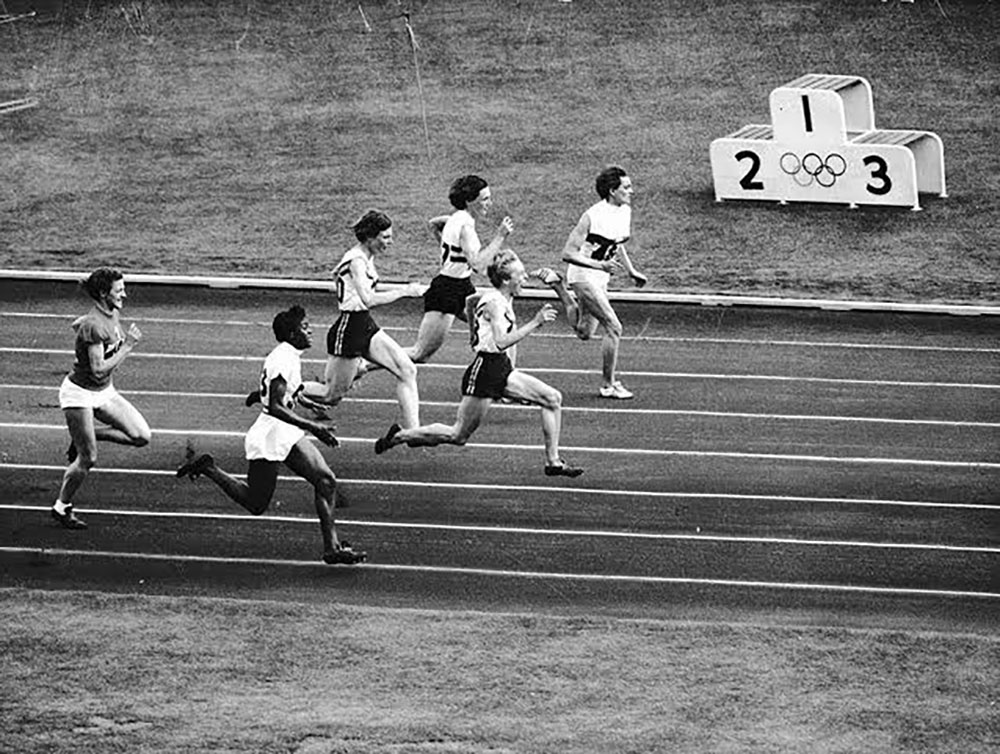
So at the 1932 Olympics in Los Angeles, Stella Walsh ran under the name: Stanislawa Walasiewicz as a member of the Polish team. With clocking 11.9 seconds, she set the world record for the 100-meter, the final and she won the gold medal for Poland. Afterwards, she returned to Warsaw to study two majors at a time; physical education and journalism at a women’s college, but that did not satisfy her so she returned to the US.
Her success in the 1932 Olympics was doubled by a silver medal for Poland in the 1936 Olympics in Berlin. She was bested by an 18-year-old American Helen Stephens by 0.2 second. This was the last time she appeared in the Olympics, at the age of 25. In 1937, tied Stephens' 100-meter record. Between 1933 and 1938, Stella Walsh ran at European Championships, Women’s World Games, various competitions, earning numerous medals and breaking records for the 100-meter, hurdles, long jump, and shot put events. Walsh announced her retirement, but she never actually quit competing.
UNSUCCESSFUL BID
But her dream was to run for the US. Because she competed for Poland, her US citizenship was naturalized in 1947 with a delay of almost 15 years. In 1954, at the age 43, she won her fifth consecutive US pentathlon championship.
Though her biggest target was the 1956 Olympics but because she has competed under the Polish flag this was nearly unthinkable. As she tried hard for everything during her entire life she managed to find a way for this as well. According to a rule stated by the IOC, ”If, a female athlete who had competed for one country were to marry a man from another, she would now be permitted to compete for her husband's country... "
The news has been heard soon. Stella Walsh revealed their marriage with Harry Olson, a former boxer -the ceremony took place in Las Vegas-. She competed at the American trials, but, after finishing third in her 200-meter heat, she failed to make it to Melbourne. Stella and Harry separated soon after but they never officially divorced but she ended up keeping his last name for nearly the rest of her life.
Along her 50’s and 60’s she coached young sprinters, continued to be active in a variety of sport associations rooted to Poland in the US, where she organized championships and helped young athletes and kids. She also funded a couple of awards for Polish sports people living in the US. Stella Walsh’s father died in 1972, and she stayed close to home, because her mother depended on her so much. In 1974, Stella Walsh was inducted into the Sports Hall of Fame.
TRAGIC END
Then came that day in December 1980. During those days Cleveland was in tough shape and her neighborhood was one of the areas which were no longer safe. One day she was out shopping. When she was in a parking lot she was approached by two men with a gun. One of the men grabbed for her purse, but Stella Walsh fought back. As she struggled to hold on to her purse, the younger of the two men, took out a gun. Stella Walsh grabbed it. The gun went off and a bullet hit Stella Walsh in the chest. She was unconscious when a policeman found her face down in the parking lot. Three hours later, while in surgery in a hospital, she died.
The autopsy revealed something surprising Walsh had a chromosomal disorder known as mosaicism.
Because it’s a cellular mutation that resulted in her having mostly male (XY) chromosomes and therefore making her intersex, she was born with sexually ambiguous genitalia. Lacking female reproductive organs, Stella was biologically unable to have children instead and she had a non-functioning, underdeveloped penis.
Stella Walsh's birth certificate listed her as a female, she was given a female name and raised female, and she thought of herself as a woman throughout her life. Walsh didn't live her life pretending to be something she wasn't. Walsh had always lived her life as a woman.
Because of her autopsy results, other athletes raced with her questioning if it was fair that they lost medals and competitions to an athlete who had male genitalia and presumably more testosterone than they did. The IOC has announced not to revoke her medals, as gender determination tests were not conducted during the years she participated as an Olympian.
Despite the gender confusion caused by the disorder, Walsh had lived her entire life as a woman. No one will ever know the story of her inner life but as one reporter described her situation; this definition will all leave us with mixed thoughts while teardrops falling from eyes:
“She wanted to be both known and unknown…”