By Yavuz YAVUZ
When the 1975 Mediterranean Games were awarded to Algeria in 1969, they were set to be a testament to a new country that recently gained independence. As the 1967 Games in Tunis became the first major international sporting event where Algeria set foot with prominent athletes as an independent nation, it was only fitting that the Mediterranean Games would also be the first major event hosted by the country. Algeria was obviously not the only country to have recently gained independence. The two decades after the end of the Second World War were marked by decolonization movements around the world, and the newly established states from which began to organize in the international sphere to manifest themselves and influence politics.
Algeria was one of them and its capital, Algiers came to host a number of international events, including the 4th Summit of the Non-Aligned Movement in 1973, the main organization of the countries newly gained independence from colonizers. Sports were one of the main priorities of diplomatic influence for these countries at the time, as it was the epicentre of an isolation policy against apartheid South Africa. With the eyes of the Third World turned on sports, a number of international events of substantial scale were held on their soil, one of them being the 1975 Mediterranean Games in Algeria.
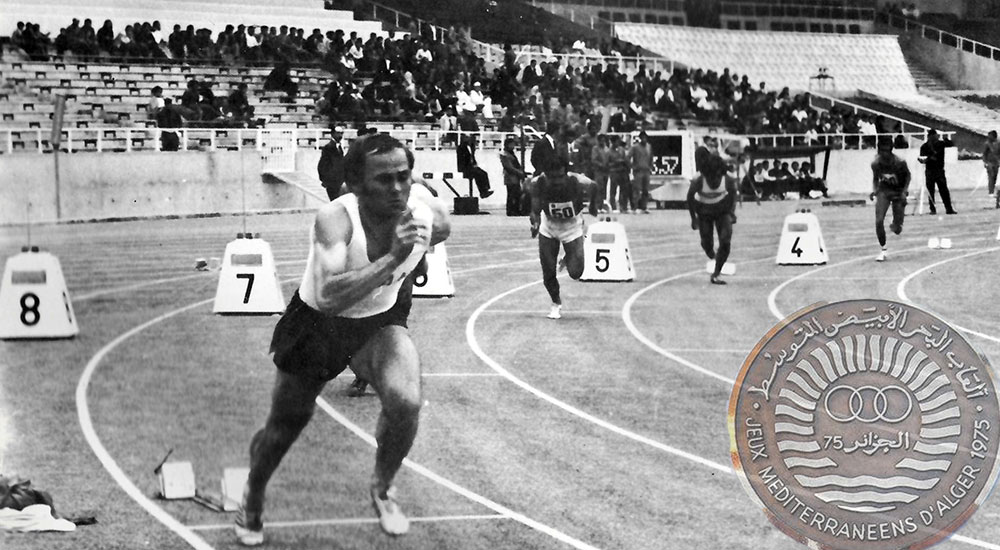
The 7th Mediterranean Games were the first large-scale international sports event to be held in post-independence Algeria. The main venue of the Games, Stade du 5 Juillet 1962 -which took its name from the day of independence- was inaugurated in 1972 as a symbol of the independent Algeria and hosted several track and field races of the athletics event that gave some of the most memorable moments of Mediterranean Games’ history.
SPRINTERS OBLITERATE GAMES RECORDS
1975 Mediterranean Games witnessed the renewing of championship records by medal holders of 19 races. Perhaps the most significant highlight in this feat was that all five individual sprint races were stage to new championship records. Pietro Mennea, the Italian sprinter who travelled to Algiers with an Olympic 200m bronze in his collection from the year 1972, completed a 100m-200m double in the Games. His 10.43 at the 100m race renewed a 16-year-old championship record, remnant from Beirut, whereas a 20.52 at the 200m race was an improvement of his own championship record mark 20.7 in Turkey’s İzmir four years ago.
Josip Alebic, the Yugoslav European Indoor silver medallist of the same year, was another championship record breaker, this time at the men’s 400m race by clocking 46.44. Women’s individual dash sprints also saw championship records broken by an Italian and a Yugoslav. Rita Bottiglieri of Italy broke the championship record at the 100m race during heats with a mark of 11.73 and went on to win the gold medal in the final. Jelica Pavlicic, Yugoslavian European Indoor gold medallist from the previous year, broke the championship record with 52.54 to shake off Bottiglieri in the 400m race. This was Yugoslavia’s only women’s gold at the Games, a visible drop from four in 1971 Izmir. Despite that, it should be underlined that 1975 Algiers was the most successful Mediterranean Games ever for Yugoslavia with 10 gold medals and 19 medals in total.
RAHOUI CHEERS UP THE HOME CROWD
Algerian athletes wrapped their first home games with a total medal tally of six and their sole gold medal came at the men’s 3000m steeplechase race. By clocking 8:20.2 Boualem Rahoui set a championship as well as an Algerian record to win his country’s first gold in the history of the Mediterranean Games. Some claim that Rahoui was flirting with the world record, had he not slowed down to salute crowd at the Stade du 5 Juillet. At a race run in a substantial pace, the silver medallist Jose Antonia Campos set a national record as well, for Spain.
Rahoui won another medal for Algeria, a bronze at the men’s 10.000m race, adding to the jubilation of the home crowd. Rahoui might as well bring Algeria its first Olympic medal in athletics if not for the boycott of African countries at the Summer Olympics in Montréal the next year, over the participation of New Zealand, which had held its sporting ties with apartheid South Africa.
NAIL-BITING COUNTBACK
At the men’s pole vault race, home favourite Lahar Rakhdal was deadlocked at 5.00m with two Italians, Silvio Fraquelli and Renato Dionisi, European bronze medallist from 1971. The placements on the podium were decided by a countback in which Fraquelli won the contest and the sole international medal of his career. Rakhdal was placed second and brought Algeria one of its three silvers at the Games and the most decorated of the three, Dionisi finished third.
FIRST COMBINED EVENT MEDAL FOR TURKEY
Nurullah Candan, with his bronze medal at decathlon, brought Turkey its first international medal at a combined event. Candan was placed third behind Zissis Kourelos of Greece and Eduardo Rodriguez of Spain with 7075 points. This was also Turkey’s sole athletics medal at the 1975 Mediterranean Games. Candan had broken the national record with 6676 points five years ago in Athens, which meant that he improved his own national record by 399.
MORE MEMORABLE MOMENTS
1975 Mediterranean Games also witnessed a renewed duel at the women’s high jump race, between Yugoslavia’s Snezana Hrepevnik and Italy’s Sara Simeoni. Simeoni managed to steal the gold from Hrepevnik, who beat her four years ago in İzmir. Simeoni’s 1.89m jump was also a championship record. Simeoni would go on to win an Olympic silver medal the next year in Montréal.
At the men’s long jump event, Yugoslavia’s Nenad Stekic won the gold medal with a staggering (and wind-aided) 53cm margin over silver medallist Rafael Blanquer. Stekic’s 8.19 jump in the series was the best legal jump which set a new championship record.
Women’s middle-distance races witnessed the induction of a future Olympic gold medallist to the world stage at the senior level. Gabriella Dorio, who had won the European U20 bronze at the 1500m race earlier that summer, finished second at the 800m and 1500m races in Algiers. Dorio, who would go on to win an Olympic gold at the 1984 Summer Olympics, was beaten by the 1500m bronze medallist of 1972 Munich, Paola Pigni in both races.
Omar Musa Mejbari was among the athletes who made history for their country, by winning a shot put bronze medal which became the first medal of Libya in a field event internationally.