By Yavuz YAVUZ
“I was world champion but I was never able to celebrate it.” These were the words uttered by Caster Semenya, three-time women’s 800m world champion and Olympic gold medallist in 2012 and 2016, during the ongoing legal fight against World Athletics’ (then IAAF), testosterone rules. In the years that went by, World Athletics deprived a number of athletes of moments of celebration by having them undergo demeaning and discriminatory gender verification tests while Semenya made her global debut at the women’s 5000m race of 2022 World Athletics Championships in Eugene, after five years of being barred from competition.
Alongside Semenya, Francine Niyonsaba, Burundian two-time World indoor champion as well as Olympic and World silver medallist in 2016 and 2017 respectively at 800m, was another mid-distancer sidelined by the World Athletics’ testosterone level regulations. Having made a similar transition to longer distances like Semenya, Niyonsaba came fifth at the women’s 10.000m race of the Olympics in Tokyo and won the Diamond League same year for 5000m.
Sprint specialists have been targeted by these rules as well. Most recently, Namibians Christine Mboma and Beatrice Masilingi were barred from competing at distances from 400m to one mile in the run up to the Tokyo Olympics. While Mboma became the silver medallist at the women’s 200m race Olympics, Masilingi, who holds the second-best under-18 time in history in the women’s 400m, rocked the World U20 Championships in 2021 by winning silver at both 100m and 200m races.
These athletes could not run their favourite distance because they refused to take medication to lower testosterone levels, a treatment deemed demeaning and physically unsettling. Moreover, it is also evident that these rules discriminately target black athletes. In the face of all this, the athletes’ struggle for equality and run for the top continues to manifest itself in other disciplines.
At the 2022 World Athletics Championships in Eugene, another sprinter who was disqualified from running in 400 metres made the headlines with a historic achievement. Aminatou Seyni of Niger created history after history by making the final of women’s 200m race. While all this happened at one of the shortest races of the Championships, it was a long and rough path to history.
HISTORY MAKER
Aminatou Seyni, the 25-year-old who holds the national records for Niger at all flat sprint distances, leads the table of her country’s modest medals record. Niger, while virtually absent in international competitions save the West African Championships, -and two silvers at the Jeux de la Francophonie- made it to the medal table of the African Championships for the first time in 2022 thanks to the remarkable feat of Seyni with a silver medal in the 100m and a gold in the 200m races.
Seyni’s 11.07 at the 100m heats was a national record but she really left her mark on the track in 200m races. She made the semi-finals in both 2019 World Championships in Doha and the Summer Olympics in Tokyo, narrowly missing out on the final on both occasions. However, in both events, her achievements were overshadowed by the testosterone ruling that prevented her from running in the 400-meter race. The ruling, came shortly after Seyni took the second place at the 2019 Athletissima, sidelined her from racing the distance.
Her 49.19 in Lausanne in 2019, a national record at the women’s 400m, would have won a bronze medal at the Worlds. However, despite the ban, she worked her way up the ranks of the 200m and her best showing yet took place at the 2022 World Championships in Eugene.
SHINE AT THE WORLDS
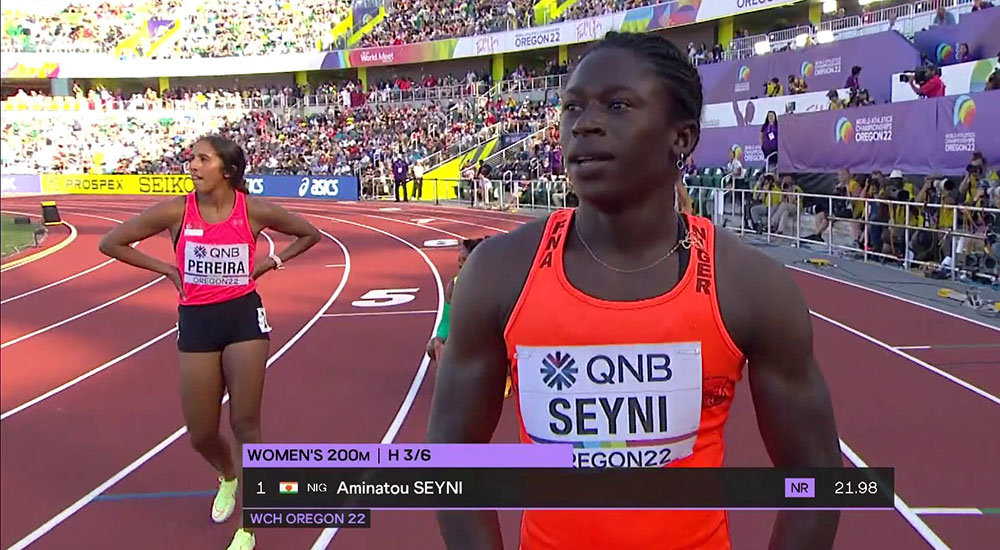
Aminatou Seyni began her World Championships campaign in the 200-meter race by defeating the legendary Shelly-Ann Fraser-Pryce at the heats. While doing so, she ran a sub-22 for the first time, renewing the national record to a staggering 21.98. This was the fastest mark ever in the first round of the Worlds. At the semi-final, Seyni kept the defending world bronze medallist Muijinga Kambundji at bay to get a direct qualification to the final. In the last 50 meters, Seyni paced her way up to the second place from fifth.
At the historic final, where Shericka Jackson broke the championship record and clocked the second fastest time ever by 21.45, Aminatou Seyni ran 22.12 and came fourth by fending off race favourites like Abby Steiner, who had the second-best time of the season, and Elaine Thompson-Herah, the Olympic gold medallist. Despite missing out the podium, she got the best result ever for Niger at the Worlds and showed very promising signs for the future.
Seyni’s World Championships campaign is yet another example of the code change forced on athletes on the basis of testosterone levels. While the debate on the regulations is far from over, the achievements of these athletes - most recently that of Seyni - show that there is no real way of striking them out.