By Şevket F. ERBAY
Today, the unchallenged super talent Yulimar Rojas is the most important reason of Venezuelan topics on international athletics scene. She is the current world record holder in triple jump and did not lose any championships since 2017. Well-deserved agenda item, for sure.
Force your memory to think deep about Venezuelan athletics. Even if you consider yourself as a core athletics fan, you probably wouldn’t remember any other Venezuelan name who recently made such a big impact on track besides Rojas. Partly you’re right, there were no other athletes who had a mark in history that big.
However, long before Yuli was born in a poor neighbourhood of capital city, Caracas, “Los Superdotados” lived in the same area. Their semi-forgotten legacy still comes in sight over historic debates but is never acknowledged rightfully.
THE SAGA CREATED BY EXILED BRAINS
Los Superdotados (The Gifted Ones) were mainly formed by talented Venezuelan generation who dominated the Latin and international scene in early 60s. They were dubbed as such by the Latin media due to being one of the most talented squads ever emerged from the continent.
Guided by the Eastern-bloc escaped trainers (Ladislao Lazar, Miroslav Dobrin and Emerico Sustic), the sprinters group had some great names of their era: Arquimides Herrera, Rafael Romero and Horacio Esteves. The Venezuelan 4x100 metres team that was formed by the aforementioned talent pool have been on top in nearly every occasion for six years. Most of the sprinters came from oil-rich Zulia State where mixed with Caribbean immigrants.
Los Superdotados have unofficially opened their account in their own land at the Central American & Caribbean Games 1959 in Caracas. Although their individual talents lost both sprint titles to Puerto Rican Manuel Rivera, they’ve got a good setback in 4x100 relay in a close-call race. Same year in September, Venezuelan quartet secured the Pan American silver ahead of the very-talented British West Indies by clocking 41.1 secs.
Venezuela’s emerging sprint phenomenon had a global impact in 1960. At the Rome Olympics, they clocked the South American record (41.11) in the heats and renewed it in semis (40.49) despite not being able to use Horacio Esteves who was injured in the heats. Without Esteves, who was replaced by Lloyd Murad, Venezuela competed in the 4x100 final with Bonas, Murad, Emilio and Rafael Romero, and finished the race in the fifth place (originally sixth, but the United States was disqualified later) amongst the titans of sport. Yet there was much more to their feelings about missing out on the Olympic medal in the Stadio Olimpico, in fact, that was huge relief.
RULES THE REGION
Just one month later, Los Superdotados stormed around the Chilean capital Santiago during the inaugural Ibero-American Games. Most prominent member of the relay team, Rafael Romero had secured both sprint golds at the Games while being accompanied by team-mates Esteves and Murad in the podium. As a natural consequence of these individual results, Venezuelan quartet bagged another title at the Games with 40.3, establishing the South American 4x100m record.
In the following season, Venezuelans made a perfect sweep in both South American Champs and Bolivarian Games with 1-2 finish in 100 and 200, plus unchallenged victories in the relay. Their ongoing form proved once more in Jamaica’s Kingston – the would-be heartland of sprinting. Kingston was the centre of CAC Games that year –a timely celebration for the newly-gained independence from United Kingdom. Venezuela raced in the Kingston’s packed National Stadium by order of Arquimides Herrera to Llloyd Murad, then 200 metres winner Rafael Romero on the curve, and followed by Horacio Esteves in the end. Predictably, that stunning formation clocked a new area record with 40.0 – huge clearance ahead of Trinidad (40.7) and Jamaica (40.8) in the much-anticipated final.
After years-long stability, Venezuela’s highly rated sprinter group placed their focus on an Olympic medal in the 1964 season. Actually, they looked rock solid in the Olympic year: Horacio Esteves equalled the 100 metres world record that year by clocking 10.0 in Caracas on 15th August; Arquimides Herrera was one of the top five sprinters in the world in 1963; Rafael Romero was Pan American, Ibero American and CAC Games 200 metres champion simultaneously. Additionally, another member of the 1960 team, Lloyd Murad had valuable NCAA experience at San Jose College recently.
But, just on the eve of the Tokyo Games, world record holder Esteves was forced out of the team due to his muscle problems. That blow might have cost a medal yet another time similarly to the Rome 1960 Games. In the 100 metres, Arquimides Herrera made the semis, went one round further from his team-mate, Lloyd Murad who was eliminated in quarters. Herrera also showed up on the 200 metres semi-final round.
THREE RECORDS BUT STILL SHORT OF MAKING HISTORY
In the relay elimination round, Los Superdotados were matched with United States. In the morning session of 20 October, Venezuela clocked 40.1 after United States, a mark which was enough to make it easily to the semis, also translated to 40.10 – new South American record. Same day, a few hours later, the qualified teams sat down to the blocks once again in order to take a berth for the final. The coach Ladislao Lazar was forced to use Hortensio Fusil in the anchor leg instead of Horacio Esteves, the missing member of “original” squad,.
The machinery team was still working well, though. They lowered the South American record to 39.65, finishing just third after Italy and Poland in semis. The perfect mark was good to reach a second consecutive Olympic 4x100 final for the Venezuelans.
On October 21, the Venezuelan team was placed a good assignment: Lane 5. They have a sight in front, the United States, Poland and Soviet Union, all of these teams were placed through the outside lanes. Arquimides Herrera left the block and turned his part in a quick response and handed the baton over to Lloyd Murad as fourth. Murad had lost little bit of time in the straight but kept the team in contention. In the third leg, the United States strengthened their lead in the lane seven while Venezuela’s Rafael Romero was trying hard to keep the rhythm in the middle lane. After the last change, France had a two- or three-meter lead and all the teams were looking pretty much even in the back.
In the final stretch, United States’ Bob Hayes produced one of the brightest relay legs the world has ever seen (predicted under 9.0 second, some sources marked his split as 8.6), which gave them a 39.0 world record and the Olympic title. Poland and France clocked 39.3 back-to-back, securing podium places and outclassing Jamaica and Soviet Union. Venezuela’s Hortensio Fusil, who was much more a 200-400 metres runner than pure sprint – came home for sixth place with 39.5 (later translated to 39.53) – which was another South American record!
Three area records in two days, but it was not enough to have an Olympic medal – that could be heart-breaking for some. On the other hand, the race was remarkable, in fact: All teams clocked under 39.6 and were placed in a tight margin of 0.6 seconds. Seven of the eight teams have broken or equalled the existing Olympic record. In the middle of that historic picture, Venezuela’s Los Superdotados bid their farewell as Olympic sixth placers.
MEMBERS IN LOS SUPERDOTADOS 4x100 RELAY
Lloyd Murad (born 1933)
Clive Bonas (1933-1960?)
Arquimides Herrera (1935-2013)
Emilio Romero (born 1937)
Rafael Romero (1938-2021)
Hector Thomas (1938-2008) – late races
Horacio Esteves (1941-1996)
Hortensio Fusil (1939-2018)
AREA RECORDS
41.11 in Rome 1960
40.49 in Rome 1960
40.3m in Santiago 1960
40.0m in Kingston 1962
39.8m in Caracas 1964
40.10 in Tokyo 1964
39.65 in Tokyo 1964
39.53 in Tokyo 1964
4x100 MEDAL SERIES
1959 Pan American SILVER
Emilio Romero, Lloyd Murad, Clive Bonas, Rafael Romero
1959 CAC Games GOLD
Clive Bonas, Lloyd Murad, Horacio Esteves, Rafael Romero
1960 Ibero-Am GOLD
Lloyd Murad, Emilio Romero, Rafael Romero, Horacio Esteves
1961 Bolivarian GOLD
Horacio Esteves, Arquimides Herrera, Rafael Romero, ?
1961 South American GOLD
Clive Bonas, Horacio Esteves, Arquimides Herrera, Rafael Romero
1962 Ibero-Am SILVER
Arquimides Herrera, Lloyd Murad, Andres Fawre, Rafael Romero
1962 CAC Games GOLD
Arquimides Herrera, Lloyd Murad, Rafael Romero, Horacio Esteves
1963 Pan American SILVER
Hector Thomas, Horacio Esteves, Arquimides Herrera, Rafael Romero
AT THE OLYMPICS
1960 Rome – 4x100 5th place
1964 Tokyo – 4x100 6th place
***
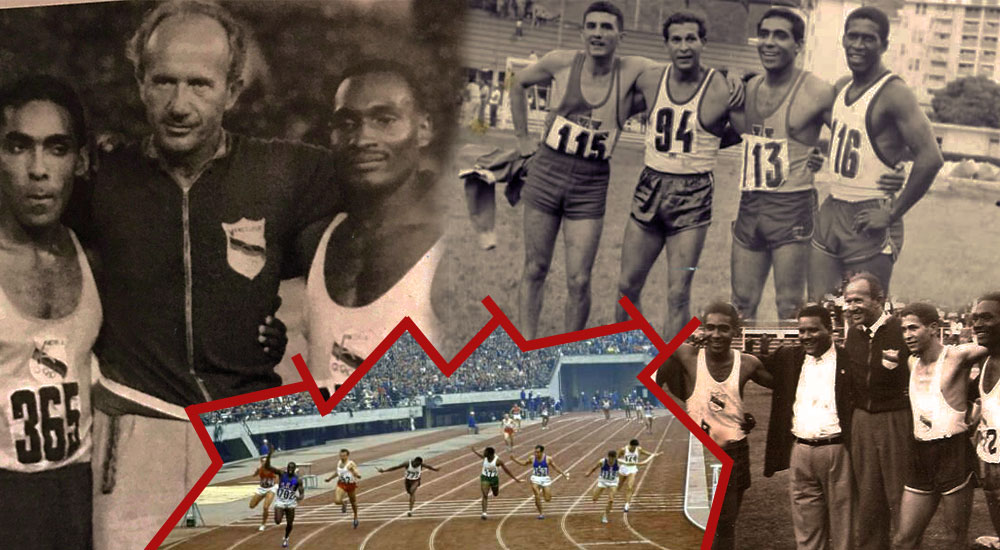
Mixed photo from left to right: Rafael Romero, Coach Ladislao Lazar and Arquimides Herrera / 1963 Pan Am Games silver medallists, Horacio Estevez, Rafael Romero, Hector Thomas, Arquimides Herrera / The joy of winning 1961 South American Championships gold (right bottom) / Finish moment of 1964 Tokyo Games 4x100 metres final (middle bottom).