By Yavuz YAVUZ
Numerous pioneers spearheaded Africa’s gradual rise as a continent to the top ranks of the international athletics through this period, and each milestone they crossed had a wider impact on the growth and evolution of the sport. Africa began to thrive in international athletics in the immediate aftermath of the decolonisation period, with the subsequent rise of the Third World project as a significant political force in global politics right around the corner. In this atmosphere, the prominence of African athletes in international sports, including athletics, became an integral part of the international visibility of the continent’s different countries.
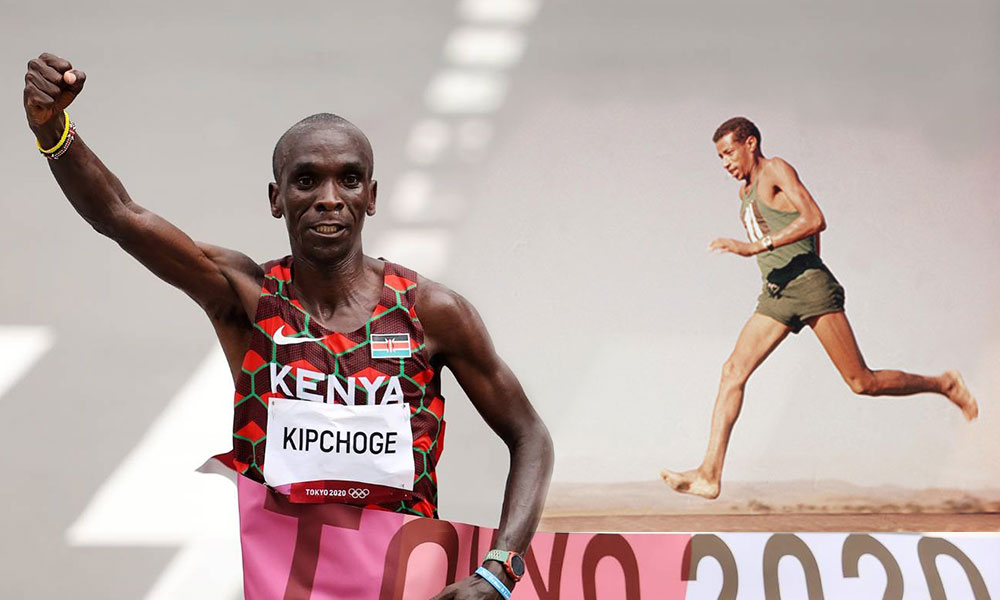
From 1960, when Ethiopia’s Abebe Bikila crossed the finish line for the gold medal of the marathon race at the Summer Olympics in Rome to Morocco’s Nawal El Moutawakel who led the African women’s sprint revolution and to Kenyan Eliud Kipchoge who smashed the marathon world record in the autumn of 2022, a number of African athletes have been the pioneers of the continent’s athletics saga. Here’s a collection of 10 African athletes, in chronological order, who transformed the codes they ran at and went on to have a wider impact on the athletics in Africa.
Abebe Bikila
Born in 1932, Bikila first became involved in sports by playing gena, a traditional game of hockey in the fields and hills of Ethiopia. The game, which required long-distance running across the playing field, formed the bases of Bikila’s stamina in long-distance racing. Having joined the Ethiopian armed forces, he began training as a runner with the Swedish coach, Onni Niskanen. Bikila won the first marathon of his running career in the summer of 1960 in Addis Ababa and clocked 2:21:23 a few weeks later, a time that was even faster than the Olympic record held by Emil Zatopek at the time.
At the 1960 Summer Olympics in Rome, the race was run in blistering heat and Abebe Bikila ran barefoot. Having felt discomfort in his new running shoes, Bikila ran the streets of Rome without them in the afternoon race and beat Morocco’s Rhadi ben Abdesselam to be the first black African gold medallist of Africa and to break the unofficial world record by clocking 2:15:16.2. The top two African finishers drastically altered athletics in the continent.
Bikila went on to win another marathon gold at the 1964 Summer Olympics in Tokyo, however, he was forced to retire before attempting a three-peat in Mexico City four years later. During the course of his career, he won 12 of the 13 marathons he ran in. Abebe Bikila suffered a car accident which left him quadriplegic and four years later, he died due to a cerebral haemorrhage related to the crash. He received a state funeral, a day which was observed as a national day of mourning.
Kip Keino
Ethiopia’s arch-rival in athletics set foot on the international scene shortly after Bikila wreaked havoc at marathon races. Kenya’s Kipchoge Keino made his name known to the world in 1965 by breaking the world record in both 3000 and 5000-meter races, clocking 7:39.6 and 13:24.2, respectively and he became Africa’s first official world record holder. At the 1968 Summer Olympics in Mexico City, despite suffering from abdominal pains, Keino ran six distance races in a little more than a week. While he failed to finish the 10.000m race, Keino won silver in the 5000m and gold in 1500m and contributed to Kenya’s eight-medal overall tally.
At the 1972 Summer Olympics in Munich, Keino was on the podium of the 1500m race once more, this time with a silver medal. In the 3000m steeplechase, he won the second Olympic gold of his career, marking the debut of a tradition of Kenyan reign in the discipline, having stepped on the top rank of the podium four years later than his compatriot Amos Biwott. While Keino retired in 1973, he continued to be involved in the sports programme of his country, leading the Kenyan Olympic Committee until 2017.
Saïd Aouita
1984 Summer Olympics in Los Angeles marked the rise of Morocco as an athletics powerhouse with two gold medals added to the country’s tally. Saïd Aouita was one of the first Olympic gold medallists of the country. Having won the country’s first World Championships medal in 1500m a year before in Helsinki with a bronze, Aouita defeated Antonio Leitão of Portugal to win the 5000m gold medal by clocking 13:05.59, an Olympic record at the time.
A year later Aouita ran two world records, in 1500 and 500 meters, having clocked 3:29.46 and 13:00.40, respectively. In 1987, he became Morocco’s first world champion in Rome, by winning the 5000m race. In 1988, he was also on the podium of the men’s 800m race, which made him the sole athlete to combine Olympic medals in 800m and 5000m distances. 1989 was the end of the pinnacle of Aouita’s career, as he won the 3000m gold at the IAAF World Indoor Championships in Budapest. He also broke the 3000m world record that year by clocking 7:29.45 and becoming the first man to run below 7:30.00. In the early ‘90s, he retired from athletics due to his deteriorating health.
Nawal El Moutawakel
Nawal El Moutawakel was among the two Moroccan gold medallists at the 1984 Summer Olympics in Los Angeles, having stepped on the top rank of the podium in the women’s 400m hurdles race. Having made the 100m-200m double at the 1981 Arab Championships and a hurdle-double at the African Championships a year later, Moutawakel became known as a prominent sprinter.
At the inaugural women’s race in the discipline of 400m hurdles, Nawal El Moutawakel clocked 54.61 to win the gold medal ahead of Judi Brown of the USA. As a groundbreaker for Arab-African woman athletes, she also won two gold medals at the Mediterranean Games, in 1983 and 1987 consecutively. After retiring from athletics, she became actively involved in policy-making in sports having served as a member of the IAAF and the IOC. She was also named as Morocco’s Minister of Sports in 2007.
Frankie Fredericks
After Namibia gained its independence from South Africa in 1990, the country set foot on the international scene with two Olympic medals in athletics. Frankie Fredericks, who competed as the world silver medallist from Tokyo 1991, left his mark on the 100m-200m sprint races at the 1992 Summer Olympics in Barcelona by winning silver in both. In 1993, he became Namibia’s first world champion in Stuttgart by winning gold in men’s 200m race by clocking a championship record of 19.85.
In 1996, Fredericks made a silver double once more, having been beaten by two world record breakers, Donovan Bailey and Michael Johnson in 100m and 200m races respectively. His second and last global gold medal came in 1999 when he won the 200m race of the World Indoor Championships. Fredericks, who later became an IOC member, was implicated in the IAAF corruption due to a cash payment he received in 2009, which is subject to an ongoing investigation.
Mary Onyali
Mary Onyali was perhaps best known for her consistency, having taken part in five consecutive Olympics from Seul 1988 to Athens 2004. At the 1992 Summer Olympics in Barcelona, she was part of the 4x100 team that became the first women’s Olympic medallists of Nigeria by winning bronze. Four years later in Atlanta, she won her sole Olympic medal in an individual discipline by coming third in the women’s 200m race. Onyali’s primary impact on sports was over the relay races, leading Nigeria’s women’s teams to gold medal in every single African Games from 1987 to 2003.
Derartu Tulu
Ethiopia’s Derartu Tulu comes from sporting family, with cousins like the Dibaba sisters (Tirunesh, Genzebe and Ejegayehu) it is safe to say that athletics runs in their blood. Tulu became the first Ethiopian and African woman to win an Olympic gold medal in athletics at the 1992 Summer Olympics in Barcelona. Specialized in 10.000m, she won another gold in Sydney 2000, becoming the only woman to achieve this twice, and a bronze in Athens 2004. Tulu was also crowned as world champion in Edmonton 2001.
Having also competed in the cross country races, Derartu Tulu won three senior world championships, in 1995, 1997 and 2000. After her world title in 10.000m, she transitioned to marathon and won London and Tokyo races in 2001. In 2005, she came fourth at the World Championships and in 2009 she won the prestigious New York Marathon.
Haile Gebrselassie
Regarded as one of the greatest distance runners in history, Haile Gebrselassie of Ethiopia was crowned at two consecutive Olympics, Atlanta 1996 and Sydney 2000, in the men’s 10.000 races and stood on six consecutive World Championships podiums in the distance from 1993 to 2003, the first four of which being on the top step. His rivalry with the Kenyan Paul Tergat at the Olympics became one of the most remarkable highlights of the competition between Africa’s two athletics strongholds. Alongside a World Championships silver in 5000m at Stuttgart 1993, Gebrselassie also won four World Indoor Championships titles, three of them in 3000m races and another in the 1500m.
Gebrselassie set 27 world records during his prolific career, including the marathon world record he set when he won the 2008 Berlin Marathon at the age of 35. When he stopped the clock at 2:03:59, it meant that he lowered his own record by 27 seconds. He also won the Berlin Marathon four consecutive times between 2006 and 2009.
Wayde Van Niekerk
The 2015 world champion in men’s 400m, South African Wayde van Niekerk was without doubt among the favourites to clinch the gold at the 2016 Summer Olympics in Rio, however, no one expected him to do that with a staggering world record time of 43.03. Earlier in the year when he broke Michael Johnson’s 17-year-old world record, he had become the first athlete to run a sub-10 seconds 100m, a sub-20 seconds 200m and a sub-44 seconds 400m, making him one of the most versatile sprinters. In 2017, he successfully defended his world title in London. The 23-year-old suffered an injury shortly after his second world title, during a charity rugby match and is still unable to make a complete return to competition.
Eliud Kipchoge
A former world champion in 5000m, crowned in Paris 2003, Kenyan runner Eliud Kipchoge made a name for himself as a marathon legend. Having obtained a bronze and a silver medal respectively at the 2004 and 2008 Summer Olympics on the track, Kipchoge transitioned to marathon in 2012. Of the 16 marathons he ran over his career, Kipchoge lost only twice, in Berlin 2013 and in London 2020, where he was the runner-up in the former and finished 8th in the latter. He became an Olympic gold medallist in the streets of Rio de Janeiro in 2016. While he won four times on the roads of British and German capitals, his biggest highlights came in Berlin. In 2018, Kipchoge broke the marathon world record by clocking 2:01:39, an improvement to the previous one by 1 minute and 18 seconds. This was recorded as the largest margin to lower a marathon world record in more than 50 years.
In 2019, during the INEOS 1:59 Challenge set in Vienna, Kipchoge ran a sub-2 hours marathon distance, under ideal conditions doctored by a support team and a group of handpicked pacemakers. In 2021 he defended his Olympic title in Tokyo and a year later, again in Berlin, he improved his marathon world record. His time of 2:01:09 meant that the record was lowered by 30 seconds.