By Yavuz YAVUZ
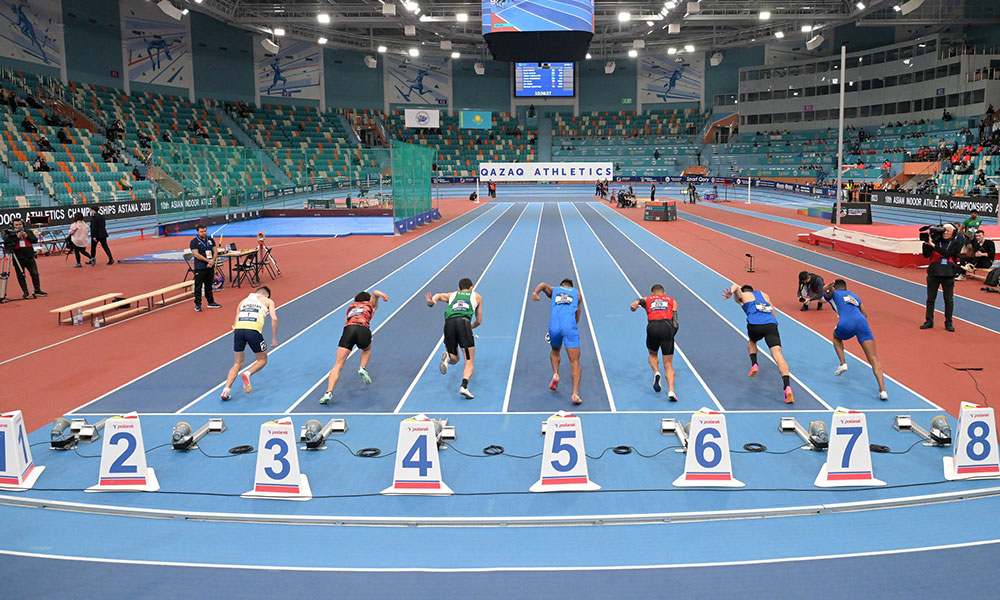
The 10th edition of the biggest indoor athletics event of the Asian continent took place during the weekend in the Kazakh capital of Astana. The event was held under the shadow of the news that the country was placed in Competition Manipulation Watch List by World Athletics a few days before kick-off. On the track, the Japanese athletes topped the medal table for the first time in the Championships’ history with six gold medals and 15 medals overall, while the hosts fared equally well in terms of the number of gold medals and came in second overall.
Japan’s remarkable performance was spearheaded by Sumire Hata, who claimed women’s long jump gold with a 6.64 leap -which is also a championship record- and Masumi Aoki who cleared the hurdles at the women’s 60mH race in a blistering time of 8.01 seconds. India’s Jyothi Yarraji, who began her indoor venture a mere three weeks ago, claimed silver in women’s 60m hurdles race by clocking a national record of 8.13 seconds.
Japanese multi-eventers proved dominant as well, with Yuma Maruyama and Keisuke Okuda earning the top two places of the podium in men’s heptathlon. Furthermore, Japan’s high jumper Ryoichi Akamatsu caused an upset by holding off Korean world silver-medallist Sang-Hyeok Woo and reaching for gold with a 2.28 jump. Syrian veteran Majed Eldin Gazal took the third place in the event as his country was struggling with the devastating impact of the twin earthquakes that took place in Turkey earlier that week.
The hosts, Kazakhstan excelled in relay races by claiming gold in both, although it should be noted that there was hardly a competition with only two teams taking the field for women’s 4x400 race. The Kazakh men’s team of Andrey Sokolov, Elnur Mukhitdinov, Vyacheslav Zems and Mikhail Litvin set a national record by stopping the clock at 3:09.15. The only podium sweep of the 2023 Asian Indoors also came from the hosts, with last year’s world indoor bronze-medallist Nadeezhda Dubovitskaya leading the pack for clearing the podium of women’s high jump. Furthermore, Kenyan-born Caroline Chepkoech Kipkirui claimed her first title for Kazakhstan, and her first international medal in 10 years, by winning the women’s 3000m race with a time of 9:01.98.
Some highlights from the individual performances included UK-born Bangladeshi sprinter Imranur Rahman, who recorded the country’s first ever medal in the Asian Indoors history with a dashing 6.59 run to gold in the men’s 60m race. The 60m race is not a part of Bangladesh’s national competition program where the shortest run is 100 meters, but Rahman managed to record a personal best in winning the gold and putting the country on the map of Asian Indoors history.
In the women’s flat sprint race, Iran’s national record holder Farzaneh Fasihi topped the field with 7.28, fending off host country’s Olga Safronova. 2018 bronze-medallist Fasihi, with this result, became the first Iranian athlete to win a gold in women’s 60m race at the Asian Indoor Athletics Championships history.
Mohamed Al-Garni, the middle-distance specialist representing Qatar, carved his name further down the history of the event by adding two more podium spots to his astonishing Asian Indoors medal record. With a gold medal in men’s 3000m race and a silver in 1500m, Al-Garni extended his medal tally to six gold and three silver medals overall, over the course of his appearances in the event.
With relatively modest interest in the stands of the Kazakhstan Sports Palace, the Championships capped off by bidding farewell to Olga Rypakova during the closing ceremony, as the 2012 Olympic gold-medallist triple jumper of the host country concluded her professional career.