Budapest’s brand-new National Athletics Center attached to Danube River is ready to host the World Athletics Championships with the presence of some of the most magnificent track stars on the planet. Starting from August 19th, more than 2000 athletes from 202 countries will be on the starting line for their respective events. At the end of the nine-day festivity – most probably – more than 40 nations will get a medal.
In athletics, most versatile sport in our life, every single event has a different story. But in general public, easy-to-watch sprinting contests are considered “the queen of the races”.
The United States was always a top contender of sprint races for years but recently they’re struggling to stay on top, except for their brilliant display in Eugene: US sprinters swept both men’s 100 and 200 metres podiums. But only on the men’s side, as US women sprinters did not claim any single medal in three dash sprint finals.
In sum, female United States sprinters have won only four out of eleven 100-metre finals in World Championships this century. Men have done much better results in the same period by winning six 100m golds at the Worlds. Ageless sprint monster Justin Gatlin ended Jamaica’s four-gold streak in London 2017, then Chris Coleman and Fred Kerley have been crowned as “the fastest man in the World” respectively.
TESTING TIME
The US sprint supremacy have been tested (and sometimes well-defeated) in the past by the Britons, Canadians, Jamaicans and other Caribbeans. But now they face a brand new territorial resistance in the sprinting: The Africans.
Africa has been a powerhouse on the athletics scene since 1970s but widely in the distance events. Believe it or not, despite producing one of the greatest names in men’s sprint, Frankie Fredericks of Namibia, the representatives of “the Black Continent” have never been on the podium in World Championships 100 metres before. In the past 18 finals, Nigeria, Namibia, South Africa and Ghana have occupied 14 spots combined, but came short of finishing on the podium. In 200 metres the picture is different, as the African medal tally hits seven, thanks to Fredericks’s enormous contribution with four medals in five contested finals.
When we apply the same perspective to women’s 100 and 200 metres, African female sprinters have stood on the podium on six occasions in history, and five of them belongs to Ivorians. And yet again, none of them was gold.
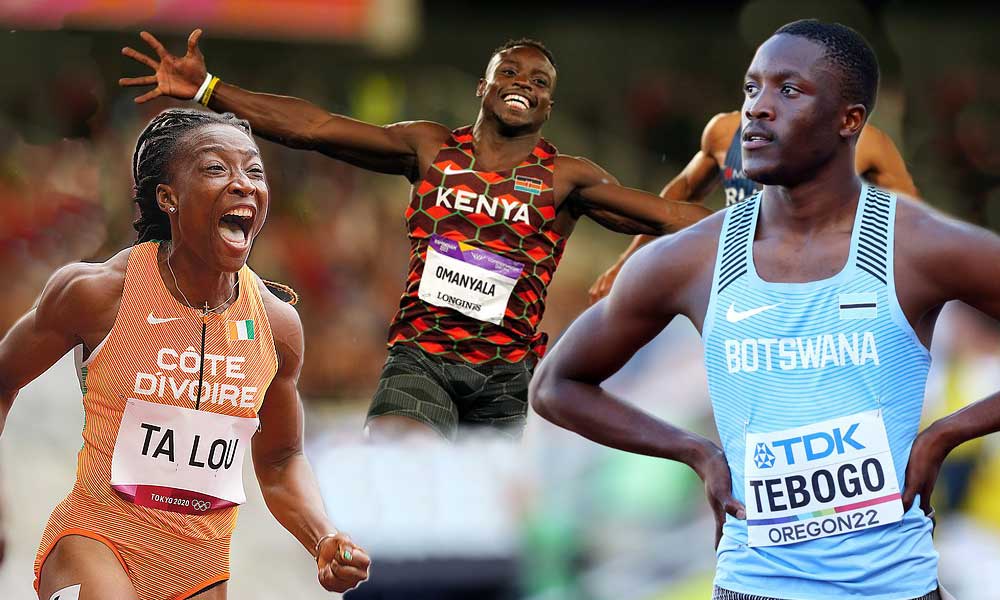
That’s the reason why we are insisting before Budapest 2023, that the Africans are possibly on the verge of a new era. Especially by taking serious consideration in 100 metres this season, African male sprinters have obtained spectacular results so far. Ferdinand Omanyala, African record holder with 9.77 from last season, will be entering the competition in Budapest with 9.84 season best and is very likely to be on top. The powerful Kenyan had not raced “properly” in Eugene last summer due to the last minute visa entry into US – he arrived only 20 hours before 100m heats. Now, he has much more focus to make history in the Hungarian capital by showing a stellar graphic this season where he dipped under 10 seconds 10 times.
OTHER HOPES
In addition to the Kenyan sensation, Nigerian Godson Oghenebrume (9.90), South African newcomer Shaun Maswanganyi (9.91), three-time 100m world finalist Akani Simbine (9.92) and Botwana’s World junior champion Letsile Tebogo (9.93) are all turning their eyes to the final berth. All the names are standing high as biggest threats to the United States and now-faded Jamaican trios. United States’ biggest star Noah Lyles is on top form currently, but he’s beatable in 100 metres as we witnessed several times previously. Even in the 200 metres, Lyles had been tested by the ultra-talented Tebogo at the London Olympic Stadium, where the Botswanan cracked Fredericks’s long- standing African record with 19.50, just behind the American.
United States and Jamaica are likely to continue their two-way battle in women’s short sprints (the last athlete to win 100 metres world title outside of these two nations was Zhanna Pintusevich of Ukraine in 2001), but they’ve Mary-Josee Ta Lou of Ivory Coast to closely watch. Ta Lou, three-time medallist at World Championships, clocked 10.75 twice in the summer – beating some top names on the Diamond League arena. The 34-year-old West African rocket will be absolutely one to watch from the African perspective, and she wants to dedicate the glory to the memory of former top coach Anthony Koffi, who passed away earlier this year.
NUMBERS ON AFRICAN SPRINTS AT WCH
Men's 100m:
0/14 - Medal/Final (4x 4th place)
Men's 200m:
7/17 Medal/Final (only gold from Fredericks 1993)
Women's 100m:
3/14 - Medal/Final (No gold, all from CIV athletes)
Women's 200m:
3/9 - Medal/Final (No gold, medals from CIV/NGR)
AFRICAN SPRINT RECORDS
Men's 100m: Ferdinand Omanyala (KEN) 9.77 - 2022
Men's 200m: Letsile Tebogo (BOT) 19.50 - 2023
Women's 100m: Marie-Josee Ta Lou (CIV) 10.72 - 2022
Women's 200m: Christine Mboma (BOT) 21.78 - 2021
Text by Şevket F. ERBAY
(Contribution from Yavuz YAVUZ)