By Yavuz Yavuz
Tokyo is set to host the World Athletics Championships for the second time after 24 years. The first edition to visit the Japanese capital was back in 1991, and it was held in the National Stadium of the time, which had been built for the 1964 Summer Olympics. The venue was demolished in 2015 for the introduction of the new National Stadium, which hosted the Summer Olympics four years ago, and now prepares to welcome spectators for a major track and field event for the first time.
The World Championships held in the venue’s predecessor witnessed some historic moments including Carl Lewis’s involvement in three world records, Soviets crowning their final world champions, and the introduction of photo finish images as well as increased digitalisation. As Tokyo is set to produce more memorable moments for the sport’s biggest standalone stage, here’s a look back at the last time World Championships were in town.
CARL LEWIS’S CHAMPS
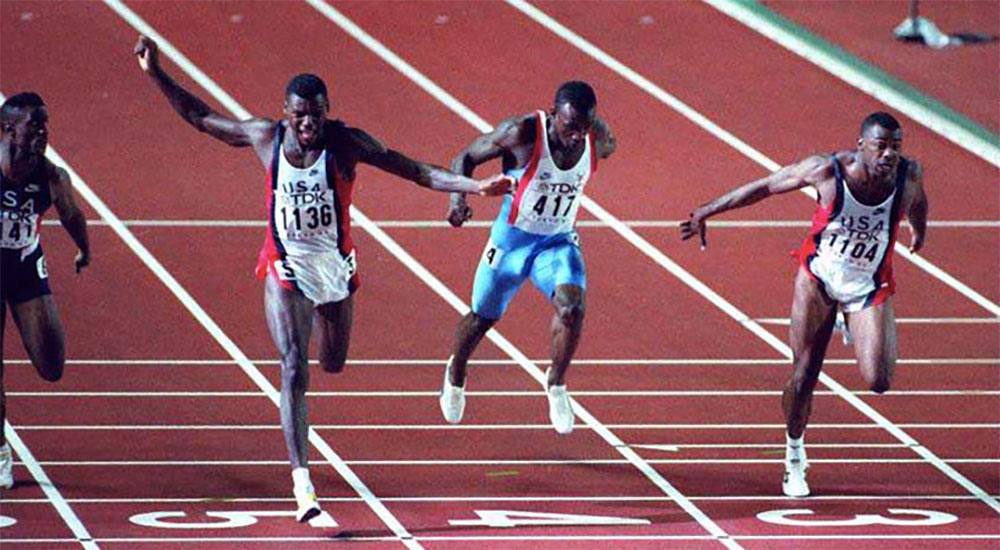
Carl Lewis had two world records by his name by the end of the event, and he helped a teammate author another one. The men’s 100m final on the third night of the championships brought together three Americans in scorching hot form with Lewis as the defending champion, Leroy Burrell having broken the world record in 9.90 seconds only a mere two months ago, and Dennis Mitchell, who was part of the world record-breaking 4x100 team in Zurich that clocked 37.67 a month earlier. The line-up also included Raymond Stewart, silver-medallist of the previous edition, and Frankie Fredericks as part of the African surge in the world of athletics.
While Carl Lewis broke the world record in 9.86, what made it more impressive that he set a world record that stood for more than two and a half years at the age of 30. It was the deepest 100m final to date with six runners under 10 seconds and two area records as well as a national record lined up firmly behind Lewis’s world record. Linford Christie broke the European record with 9.92 and Fredericks set an African record in 9.95 seconds, with Stewart’s Jamaican record of 9.96.
Lewis was also a part of the men’s 4x100 team that lowered their own world record by 0.17 seconds to 37.50. But his real showdown was in the long jump final. Lewis had a 65-competition winning streak by the time he came to the World Championships final which included the event final in Seul 1988 where he edged Mike Powell. Lewis began by leaping to a championship record of 8.68 metres, before extending his mark to a wind-aided 8.83 in his third attempt. In his fourth attempt, Lewis, with a +2.9 m/s wind, produced a 8.91-metre leap, first ever beyond Bob Beamon's record at the time. It was then, at the fifth attempts, Powell responded with a world record of 8.95 metres that still stands to this day. What made it even more glamorous was that Powell bested Beamon’s 23-year-old record in low altitude. For many, this was the greatest duel ever.
USSR BIDS FAREWELL
This was the last time USSR flag was flown on global stage, and the first time Germany competed after the unification. Soviets bid farewell with the most medals of the event, 29, nine of which were gold. Lyudmila Narozhilenko won Soviet Union’s first and last 100m hurdles title and another significant triumph belonged to Liliya Nurutdinova, who fended off stars like Ana Quirot, Ella Kovacs, and Maria Mutola to become the first Soviet athlete to become a world champion in 800 metres.
Sergey Bubka set a championship record at 5.95 metres in men’s pole vault and claimed his third and last world gold under the red banner of socialism before going on to win three more world titles for Ukraine. It was also the first time the women’s 4x400 quartet that set a still-standing world record in Seul 1988 took to the global stage, and they won gold in a championship record time of 3:18.43.
Germany won five gold medals, including Katrin Krabbe’s 100-200 double, and Heike Henkel’s women’s high jump gold that saw the athlete spectacularly clear 2.05 metres.
AFRICANS ON THE RISE
African athletes won a grand total of 17 medals in the event, marking the arrival of the continent to the global scene. All gold medals in distance races from 800 to 10,000 on the men’s side went to African athletes, with Noureddine Mourceli, who would go on to be an Olympic champion in 1996, topping the 1500m field with the rest of the titles going Kenya’s way. On the women’s side, Hassiba Boulmerka culminated Algeria’s strong legacy in 1500m with a gold.
Frankie Fredericks also made his big splashdown in the big scene with a silver medal in men’s 200 metres. He would win the title in the next championships in 1993, after being Namibia's first Olympic medallist with silver medals in both the 100 and 200 metres. Samuel Matete, Zambia’s sole world medallist stepped on the first of his three podiums with a gold in 400m hurdles, and he was on the highest point of his career. This was his country’s first and only gold medal in the Worlds to date.