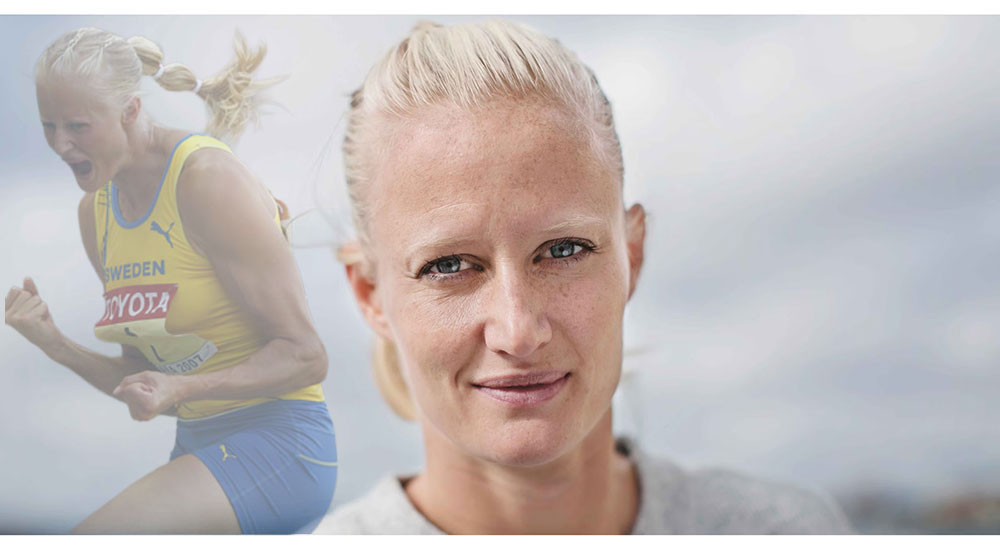
Carolina Klüft, one of the most irreplaceable names of athletics is now in her forties… Aside from the magnificent career she built over a decade, she holds a distinct place nearly for all with her exemplary character as well.
Text by Sevket F. ERBAY (*)
I, like most people, held a special interest for legends when I began preparing hand-made sports magazines with coloured pens at a young age… I prepared special issues, tried to blend Muhammad Ali, Pele, Carl Lewis and Mark Spitz in the same list and “published” different line-ups. As I grew older, I realized this was the opiate of sports publishing. These “GOAT” lists, where definitive results are almost impossible to reach, gained such an immense outreach that the abbreviation made it into dictionaries as a definition.
I am on the side that prefers individual choices over GOAT lists. Sometimes a hero shows up, gives direction to your life and means a lot more to you than the light that travels the universe. Carolina Klüft, who still holds the European record in heptathlon with 7032 points, is such a hero for most athletics-lovers in her generation.
Klüft bid farewell to athletics on 2 September 2012 at Finnkampen. I wrote a piece about her that month, titled “Impossible to replace”. In the 11 years that passed, Nafissatou Thiam took the stage, as well as two Olympic golds, but my view stayed the same.
Carolina Klüft, the Olympic champion of Athens 2004 in heptathlon, was born on the second day of February in 1983 in Sandhult and grew up in Vaxjö - pronounced as Vek-hua - where her family still lives. Although she begins the conversation on the environment where she grew up in with a reluctant “Actually I am not that into nostalgia”, the picture she draws sends a heart-warming Swedish cold breeze.
“With three sisters, my family was very physically active. I did challenge my body in different ways already then, even if I did not do athletics like every week, I did it more spontaneously. I grew up 10-15 kilometres outside of Vaxjö, with about 90,000 people, in a small village that didn’t even have a grocery store. With a soccer field and a primary school, that was a safe environment to grow up. The kids used to go home to each other, knocking up to doors, saying “Hello, do you want to play games?” We were going to the forest, just running around. My father was a soccer player before I was born, and he moved around Sweden because he changed clubs. At the end of his career, my parents wanted to move back to Vaxjö because they got children. They are still there, not in the same house, but around Vaxjö.”
PERFECT CHEMISTRY
It was Agne Bergvall, a former decathlete who coached the Vaxjö athletics team, who turned Carolina, the daughter of Johnny Klüft and Ingalill Ahlm, a national-level long jumper, into a world-renowned star. Klüft says the following on what is considered as one of the most fruitful athlete-coach duos in history:
“I met my coach when I was 16 years old. Before that, I had my mom in training. I started with soccer, had nothing more to choose in my village, except football. When I was 11-12, I started athletics. When I changed to Agne, I wouldn’t say I took it seriously because of the so much playfulness. I got a training group which included 15-20 athletes. We didn’t train together, but we were a group in the club. Arne really understood me, he let me be myself. He knew that I wanted to play, I wanted to enjoy. I didn’t want to sit around, counting points, you could do it. Just let me compete. Not being serious, that was key for me. Of course, I was doing twelve practises a week, with a lot of playfulness in the training and in competition all the time.”
This well-summarized mentality carried Carolina Klüft a few steps ahead of her rivals in terms of performances. She demonstrated the best example of this at Paris 2003, which was her first World Athletics Championships experience. Completing the first day at Stade de France by recording personal bests in four events (13.18 in 100m hurdles, 1.94 in high jump, 14.19 in shot put, 22.98 in 200m) she struggled in long jump in the morning of the second day. While the Swede faulted in her first two attempts, her French rival Eunice Barber, whose specialized event was long jump, leapt to 6.61 metres.
“It was my first World Champs after I won the European title the year before. I got the perfect first day with personal bests in all four events. I was focused, fast and strong. But didn’t really know how I could cope after two faults. It just happened. Before my third jump, If I had a fault, it was over, you know. I tried not to think about that. I learned from other competitions to focus on the best scenario. I played it in my mind, it was a good jump, white flag, kept my focus on that; having a good jump. All my family was there, but half of them were gone before the last jump because they were nervous. At that time, the key was Agne. He was so calm, came up to me and said, ‘Just go back one foot, just do the same what you did in second attempt, ok?’ He didn’t stress out. He didn’t seem nervous. That really gave me calm and focus. But it was hard, surely.”
Klüft jumped to 6.68 metres on her final attempt and went on to win the world title at the end of that day. As she showed this extraordinary mental strength countless times over in the years to come, she engraved her name in history as one of the athletes with the highest capacity of overcoming pressure. After her world title in Paris with 7001 points, she clinched the Olympic gold in Athens by an unprecedented 512-points margin. Then came other world titles in Helsinki and Osaka, and another European gold in Gothenburg… In sum, she did not lose a competition until 2008.
In the year of the Olympics in Beijing, deciding that she was no longer able to perform intense training for heptathlon, Klüft began focusing on triple and long jump. One of her first attempts at a double that year was during the European Cup First League competition in Atatürk Olympic Stadium in İstanbul (She came in first in long jump with 6.87 and third in triple jump with 14.10 but Sweden finished the pool fifth with 84 points) She took part in the long jump final in Beijing Olympics and finished eighth, whereas she took the fourth place in the world at Daegu 2011. Carolina was 29 years old when she left from athletics with a glorious send-off joined by all her friends. She ran 3:36.29 with the Swedish 4x400 relay and reached the finish line one final time.
A NEW LIFE
Nearly a decade later, Klüft, who holds a distinct place in the “golden generation” of stars including Christian Olsson, Stefan Holm and Kajsa Berqvist, who carried Sweden to the top, still holds optimism about the fallen-from-grace Swedish athletics.
“In all sports, all countries have some up and downs. We have three medals here [in Budapest] in the World Champs, it’s a good number for such a small country like Sweden. We had five in Paris in 2003. So, we can claim more medals in future. And we’re hoping for the young generation to come up and take a step into the senior arena to do something good. But of course, you need good support, some race experiences and team spirit.”
I also ask about Maja Askag who won two gold medals at 2021 World U20 Championships. She holds a trust in Askag, who she mentors despite a very busy working schedule:
“I see good future for Maja Askag. But she still needs some improvements, like speed, timing and so on. I think Maja will be one of our future stars if she can be free from injuries and has a good transition. Actually, me and my husband are just like a team leader for young athletes that are going ahead for the Olympic Games. Maja is one of the members of this nine-athlete group. That’s good but only a little part of my life, because I have a full-time job and three little kids, I’m quite busy. Anyway, I try to keep some foot in the sport which I love very much.”
Klüft now lives in Norrköping with Patrik Klüft, former world bronze-medallist pole vaulter with whom she married in 2009. [Update: They divorced in 2025 after 16 years of marriage.] The couple has three daughters: Lale is nine years old, Amy is six and Nova, the youngest is four. “Amy is very active” says Carolina, “She wants to do everything, skiing, hockey, athletics… I don’t know if she will choose athletics though”.
While she attends events in Sweden as UN’s goodwill ambassador, she focused more on her job as a director at Generation Pep. - An organization based in Stockholm, operating with support from Swedish Royal Foundation - Klüft, who previously took part in social work in Africa, likes her job at Gen-Pep focusing on healthy nutrition and growth of children: “I’m a Goodwill Ambassador for UN Sweden, trying to do my best to make the world a better place. Sounds stupid sometimes, honestly. But I’m operations manager with an organization working for children’s health, physical activity and nutrition in Sweden. I still have interest on international questions and hold them close to my heart but now my main focus is on sustainability. My job right here is for kids in Sweden to have a better opportunity to get healthy and live a happy life.”
As the clock runs out on the half hour she spared for this delightful conversation, I turn back to athletics and ask her about Nafissatou Thiam. How does she see the Belgian’s chances, who stands as the sole contender for her 7032-point European record in Osaka?
“I still think Nafi Thiam has a good potential. She can break the European record, of course. She is struggling with injuries now. Mind it, it’s really hard to be on top in heptathlon for a long time. If she can be injury-free and also has some luck during competition, she’ll do the European record, I’m sure of it.“
(*) This interview recorded in Budapest and first published in Istanbul-based The RIVAL online magazine in September 2023.