By Yavuz YAVUZ
World Athletics Championships in Eugene arrived on the Hayward Field with a one-year delay due to the COVID-19 pandemic and put out a series of record-laden races. In addition to the 13 championship records renewed, two staggering world records on the track and one on the field were produced. Moreover, the World Championships witnessed the rise of new stars as well as the fall of some familiar faces. Here is a compilation of main takeaways from the past 10 days in Oregon.
ABOVE AND BEYOND
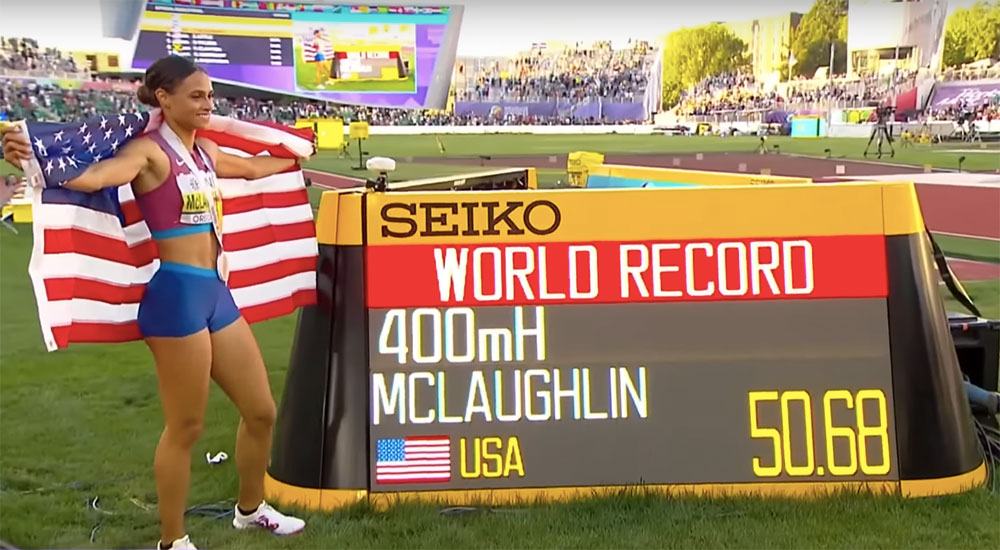
The first world record of Eugene 2022 came from Sydney McLaughlin, one of the usual suspects. The American, who also broke the world record for women’s 400m hurdles with a 51.41-run at the Nationals in June, set a new record with 50.68 in the final to capture gold, a time which would have placed seventh in the flat 400m final of the event.
Armand Duplantis, who set an overall best mark with 6.20 at the World Indoors this year in Belgrade and an outdoor world record with 6.16 in Stockholm catapulted to history with an astonishing 6.21 vault to cap off the 2022 World Championships. Mondo completed his gold collection by adding a world title as well.
The most surprising world record came in the semi-final of 100m hurdles where Tobi Amusan of Nigeria clocked 12.12. After breaking the African record with 12.40 in the heats, Amusan paced to world record in the semi-final in one of the fastest races of the event, laden with two other national records. While Amusan ran 12.06 in the final, it was disregarded from the records table due to a +2.5 tailwind. Be that as it may, the 25-year-old became the first Nigerian woman to break a world record.
CRUMBLING GIANTS
Had it not been for the invincible Malaika Mihambo’s long jump gold on the final day, Germany would conclude the 2022 World Championships with a solitary bronze medal, that of women’s 4x100 relay team. The only times when Germany failed to win a gold medal since 1983 were in 1987 and 2003, whereas Eugene 2022 became merely the third time after 2005 and 2017 when the country managed to win solely a single gold medal. Overall, the two medals were the fewest count of the Worlds history (starting from 1983) for Germany. The first ever relay podium in 13 years, with the women’s 4x100 team repeating the podium from home games in Berlin back in 2009, was somewhat a consolation.
Kenya was also a country which did not meet the expectations. While the (mid-) distance medals of the final days added to the overall medal count of 10 (two golds, five silvers and three bronzes), Kenyans finished fourth at the medal table, recording their first time outside top three since Helsinki 2005. Emmanuel Korir in men’s 800m and Faith Kipyegon in women’s 1500m won the country its sole gold medals whereas in the 5000m and 10000m races Kenyans settled for silver. 3000m steeplechase, a code under Kenyan embargo, saw the country’s hegemony dwindle with Conseslus Kipruto at the men’s race becoming the only medallist with bronze.
Poland, the relay nation, suffered a heavy blow upon returning home with no medals at the relay races. The last time this happened at a major event was in 2016 during the Olympics in Rio. Their only finals came at the 4x400 mixed and men’s races, while the former team missed out on the podium by placing fourth, the latter came last.
COUNTRIES’ FIRSTS
Peruvian racewalker Kimberly Garcia Leon opened her country’s register at the all-time medal table of the Worlds with two statement-making gold medals. On the very first day of the championships, Kimberly Garcia clocked a national record of 1:26:58 to win the 20km racewalk as well as Peru’s inaugural medal of the Worlds history. It was only a week later when she broke the championship record -and area record- with a dashing 2:39:16 at the 35km racewalk and won her and Peru’s second ever medal, again a gold. Garcia also became only the second athlete to achieve the racewalk double, after Robert Korzeniowski feat at the 2000 Summer Olympics.
At the men’s pole vault race where Mondo Duplantis broke the world record yet again, Ernest John Obiena made history for Philippines. With his 5.94 vault he did not only broke the area record, but he also secured a bronze medal which put Philippines on the map of World Championships medal winners.
Spain was another country which witnessed a first, this time in a relay race. At the women’s 4x100, the country’s relay team broke the national record in the heats by clocking 42.61 and securing a place at the final for the first time ever. They renewed the national record once again with 42.58 at the final and finished fifth.
Ersu Şaşma, who became Turkey’s first ever Olympic pole vault finalist last year in Tokyo, continued the feat to reach the Worlds final and produce his country’s only first-8 finish. The Mediterranean Games champion repeated his own national record of 5.80m which secured him the eighth spot of the men’s final.
SPOTLIGHTS
The 200m races witnessed historic moments as Jamaica’s Shericka Jackson ran the second fastest time ever by 21.45, just 0.11 off Florence Griffith-Joyner’s world record in the women’s final. Noah Lyles on the other hand, broke Michael Johnson’s long-standing US national record of 19.32 by clocking 19.31.
Sifan Hassan, who produced a historic treble by winning medals in 1500m, 5000m and 10000m races at the Olympics last year, failed to step on the podium at the Worlds, where she raced 5000 and 10000m. In the 5000m race she was placed sixth and in the 10000m she clocked 30:10.56, just shy of the top three.
Heptathlon races produced one of the highest overall points with three athletes going for national records and two others for personal bests while gold medallist Nafi Thiam finished with 6947 points.
Olympic co-gold-medallist Mutaz Essa Barshim became the first ever male high jumper to win three consecutive gold medals.
Allyson Felix, the most decorated athlete ever of the championships extended her medal collection at the Worlds to 20 with a bronze in 4x400 mixed and a gold in women’s 4x400 races.
Dominic Republic’s 4x400 mixed relay team won the country’s third ever World Championships gold medal. The only other golds were by the legendary hurdler Felix Sanchez in 2001 and 2003. Marileidy Paulino’s 48.47 split and Fiordalize Cofil last-50m attack on the anchor won another gold for the country’s productive relay machine.
At the women’s 4x100 final, Britain’s Daryll Neita ran a 9.69 anchor leg, which became the second fastest recorded anchor leg run after Christine Arron of France clocked 9.67 at Budapest 1998 European Championships. Sydney McLaughlin produced another historic run at the women’s 4x400 final, where she clocked a 47.91 split anchoring US to gold medal. Only American to run a faster split is Allyson Felix with 47.72.
Australian high jumper Eleanor Patterson equalled the area record with a 2.02 jump and won gold before Yaroslava Mahuchikh. She became the sixth gold medallist of Australia in women’s events.